

Core takeaway: The first rung of the career ladder is being sawed off—not by mass layoffs, but by a quiet retreat from hiring the young into the jobs that once taught them how to work.
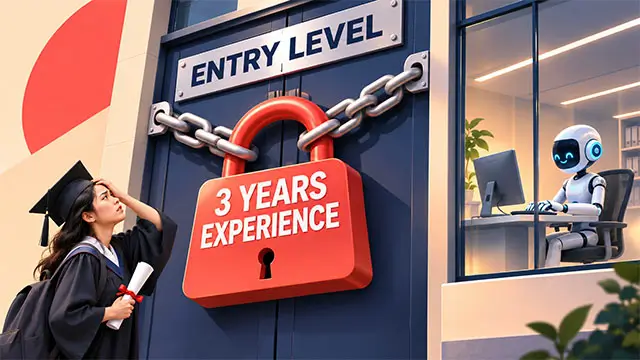
The Disappearing First Step
Entry-level work has historically functioned as an apprenticeship by another name: a place where imperfect candidates learned judgment, absorbed institutional knowledge, and made their mistakes on low-stakes tasks. That function is eroding. Global entry-level job postings have fallen by 29 percentage points since January 2024, according to Randstad’s analysis of 126 million job listings. Roles requiring zero to two years of experience now make up a shrinking share of total openings, and a survey of 183 employers by the National Association of Colleges and Employers found that more than half rated the 2026 market for graduates as poor or fair, projecting only a 1.6% increase in hiring.
What AI Is Actually Doing
The sharpest evidence comes from the Stanford Digital Economy Lab. A working paper released in November 2025 found that workers aged 22 to 25 in the most AI-exposed occupations—software development, customer service, programming—experienced a 16% relative decline in employment after the spread of generative AI, even after controlling for firm-level shocks. Crucially, older workers in those same occupations did not suffer the same decline, and entry-level jobs with low AI exposure held steady. The pattern is not general youth unemployment; it is a targeted withdrawal from the specific junior tasks that AI now performs cheaply and quickly.
A Fortune 500-focused survey of more than 600 recruiters confirms the mechanism: one-third of employers say they are replacing entry-level jobs with AI, rising to 40% in technology roles. The result is what labor economists call the “experience trap”: to get a job you need experience; experience came from entry-level jobs; entry-level jobs are the ones being automated.
It Is Not Only AI
Intellectual honesty requires a wider frame. Retail, food service, hospitality, and blue-collar entry roles—sectors with minimal AI penetration—are struggling just as much. Post-pandemic hiring has slowed broadly, and young people are always the most exposed to a hiring freeze because they have no tenure to protect them. The New York Fed reported that the unemployment rate for recent college graduates rose to 5.6% in late 2025, while underemployment reached 42.5%. Globally, the International Labour Organization put youth unemployment at 12.4% in 2025, leaving roughly 67 million people aged 15 to 24 without work. AI is not the sole cause. It is an accelerant applied to a transition already made fragile by slower growth and employer caution.
The Talent Doom Cycle
The long-term consequence is what CNBC, drawing on industry interviews, calls a “talent doom cycle”. Firms that refuse to hire and train juniors solve a short-term cost problem and create a long-term scarcity problem: in a decade, there will be no mid-level or senior talent because no one was permitted to become it. A survey by the Chartered Institute of Personnel and Development found that 62% of UK employers expect AI to eliminate junior roles, a calculation that looks efficient in a spreadsheet and self-destructive in a workforce plan.
What the Ladder Requires
The fix is not to pretend AI has no role. It is to rebuild the bottom rung deliberately. The International Labour Organization recommends designing entry-level jobs around the skills actually needed, assessing what candidates can do, and investing in onboarding that allows young workers to develop on the job—“entry-level jobs should be a place to gain experience, not a place where experience is already a prerequisite”. MIT Technology Review adds that governments must incentivize hiring and training, and businesses must recognize that a workforce fluent in AI is built from the bottom up, not purchased ready-made at the top. The ladder is broken. It can be repaired—but only if employers stop treating its first rung as disposable.