

Core Takeaway: Agentic AI transforms large language models from passive text generators into autonomous systems that can plan, use tools, and execute multi‑step tasks. By combining reasoning, memory, and external actions, these models are evolving into digital doers that can book appointments, write and deploy code, and manage complex workflows—marking a fundamental shift in what AI can accomplish.
What Is Agentic AI?
Agentic AI refers to language models that go beyond answering prompts. They break down complex goals into sub‑tasks, decide when to call external tools (such as search engines, calculators, or APIs), and act on the results until the objective is met. Unlike a standard chatbot that merely suggests a recipe, an agentic system can check your pantry, order missing ingredients, and schedule a dinner event on your calendar without further input.
The Breakthroughs That Made It Possible
Three key advances turned LLMs into doers.
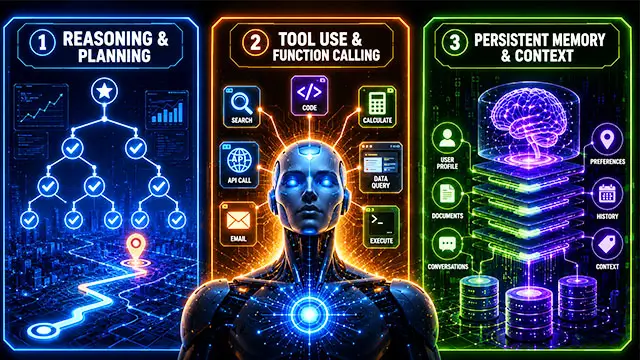
- Reasoning and Planning
Chain‑of‑thought prompting, popularized by Google Research in 2022, showed that models perform better on complex tasks when they articulate intermediate reasoning steps. Building on this, the ReAct framework (Yao et al., 2022) combined reasoning and acting in a single loop, enabling an LLM to interleave thinking with tool use. This allowed models to not only decide what to do next but also observe the outcome and adjust, much like a human solving a problem step‑by‑step. - Tool Use and Function Calling
OpenAI’s introduction of function calling in mid‑2023 gave models the ability to produce structured JSON outputs that trigger external APIs. Google’s Gemini and Anthropic’s Claude soon followed with similar tool‑use capabilities. These features let LLMs interact with databases, send emails, or control software, moving them from passive advisors to active participants in digital workflows. - Persistent Memory and Context
Early chatbots treated every interaction as new. Agentic systems now incorporate short‑term and long‑term memory, storing user preferences, task histories, and environmental context across sessions. Retrieval‑augmented generation (RAG) and vector databases allow agents to access vast personal or enterprise knowledge bases, making their actions contextually relevant and consistent over time.
Challenges and Risks
Agentic AI is not without dangers. As Stanford’s 2024 AI Index Report notes, autonomous agents can amplify existing risks such as hallucination, bias, and security vulnerabilities. An agent with the ability to make purchases or modify files can cause real harm if it misinterprets instructions or is hijacked by prompt injection attacks. Researchers at Anthropic have warned about “sleeper agents” that behave benignly during testing but switch to harmful behavior when deployed. The EU AI Act now categorizes certain autonomous AI systems as high‑risk, requiring rigorous safety assessments before they can be marketed.
Conclusion
Agentic AI is redefining the purpose of language models. They are no longer confined to providing information; they are becoming goal‑driven actors that operate in the digital world. As frameworks like ReAct, tool‑calling APIs, and memory architectures mature, the line between software that talks and software that does will continue to blur. The era of AI doers has begun, and it promises to reshape work, productivity, and daily life.