

Core Takeaway: Artificial intelligence is turning drones from remote‑controlled toys into autonomous aerial robots that deliver packages, monitor critical infrastructure, and save lives during disasters. Advances in computer vision, real‑time data processing, and flight autonomy are unlocking massive commercial and humanitarian value. However, the widespread deployment of AI drones also raises urgent questions about airspace regulation, privacy, and safety.
The New Face of Delivery
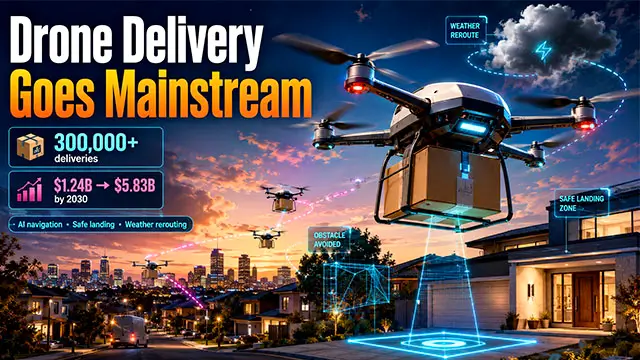
Drone delivery has moved from pilot tests to daily operations. Alphabet’s Wing and Amazon Prime Air are now conducting commercial deliveries in select cities. Wing alone had completed over 300,000 drone deliveries by mid‑2023, with items dropped within minutes of ordering. Meanwhile, Amazon’s Prime Air aims to scale its 30‑minute delivery service, having received FAA approval for beyond‑visual‑line‑of‑sight (BVLOS) flights in the U.S. The economic prize is substantial: MarketsandMarkets projects that the global drone package delivery market will grow from $1.24 billion in 2023 to $5.83 billion by 2030. AI makes this possible by enabling drones to navigate obstacles, detect safe landing zones, and reroute around weather without human intervention.
Surveillance from Above
AI‑powered drones are also transforming surveillance and infrastructure monitoring. In agriculture, drones equipped with multispectral cameras and machine learning algorithms scan crops for disease, count livestock, and optimize irrigation. DJI, the world’s largest drone manufacturer, reports that its agricultural drones have treated over 300 million hectares of farmland worldwide, cutting water and pesticide use significantly. For public safety, law enforcement agencies use AI drones for search operations and crowd monitoring. The global commercial drone market, valued at $31.1 billion in 2023 according to Drone Industry Insights, is increasingly driven by intelligent surveillance applications. These systems can track moving objects, recognize license plates, and alert operators to anomalies in real time—tasks that would be impossible at scale with human monitoring alone.
Disaster Response and Search and Rescue
In disaster zones, AI drones have become indispensable. After Hurricane Ian in 2022, the FAA issued hundreds of emergency authorizations for drones to assess damage, locate survivors, and guide first responders. DJI’s “Lives Saved” tracker records that drones have been directly involved in rescuing over 1,000 people globally. AI algorithms process aerial imagery to identify survivors under rubble, map flood‑affected areas, and create 3D models of disaster sites within hours. Because AI drones can fly autonomously even when GPS and communication networks are down, they operate where manned aircraft cannot, providing critical situational awareness during the “golden hours” of rescue.
Challenges and the Regulatory Horizon
Despite their promise, AI drones face significant hurdles. The U.S. FAA’s Remote ID rule and the European Union’s U‑space framework seek to integrate drones safely into busy airspace, but full BVLOS operations without visual observers remain constrained by regulation. Privacy advocates, including the ACLU, warn that AI‑powered surveillance drones could enable mass tracking of individuals, necessitating strict data protection laws. And there are security risks: drones can be jammed, hacked, or weaponized, which demands robust cybersecurity and counter‑drone measures. Nevertheless, regulatory frameworks are evolving to balance innovation with safety, and the drone industry is working closely with governments to establish traffic management systems for low‑altitude airspace.
Conclusion
AI‑powered drones are reshaping commerce, security, and humanitarian aid. As computer vision and autonomy improve, their applications will only expand. The challenge for regulators and society is to foster this innovation while building guardrails that protect privacy, ensure safety, and maintain public trust. The age of the intelligent aerial robot has arrived, and it is here to stay.