

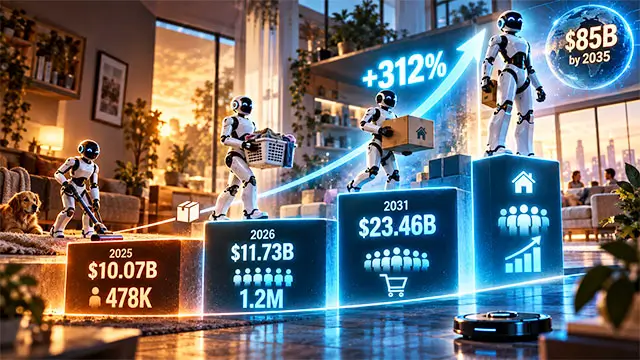
Core takeaway: After decades of overpromising and underdelivering, home robots are finally entering a transformative phase in 2026. With global household robot shipments set to exceed 1.2 million units this year — up 312% from 2024 — and major players from LG to SwitchBot unveiling general-purpose humanoid helpers, the vision of a robot that genuinely assists with daily chores is no longer science fiction. This time, they might actually work.
The Market Is No Longer a Niche
The numbers tell a compelling story. The global household robots market is projected to grow from $10.07 billion in 2025 to $11.73 billion in 2026, ultimately reaching $23.46 billion by 2031 at a compound annual growth rate of 14.87%. Other analysts are even more bullish, estimating the market could hit $85 billion by 2035.
But the real story is in shipments. In 2025, global family service humanoid robot shipments reached 478,000 units — a staggering 312% increase from 2024. By the end of 2026, that figure is expected to surpass 1.2 million units. The market is transitioning from a niche, high-consideration purchase to a mainstream consumer durable.
What’s Different in 2026?
The CES 2026 showcase in Las Vegas marked a watershed moment. LG Electronics unveiled LG CLOiD, an AI-powered home robot with two seven-degree-of-freedom arms and five independently actuated fingers per hand, designed to perform tasks like cooking and laundry. SwitchBot introduced the Onero H1, a humanoid robot with 22 degrees of freedom that can fill coffee machines, load washing machines, fold clothes, and even wash windows. SwitchBot calls it “the most accessible AI household robot”.
Zeroth Robotics emerged from stealth with a five-robot lineup, led by the M1 — a 15-inch home humanoid available for pre-order starting at $2,899. Weave Robotics launched Isaac 1, a wheeled home humanoid priced at $7,999 (or $449 per month) that folds laundry, tidies rooms, makes beds, and puts away toys. And 1X Technologies began shipping its $20,000 Neo humanoid to U.S. households.
Three Forces Driving the Revolution
First, artificial intelligence has reached a tipping point. LG’s CLOiD is powered by Vision Language Models and Vision Language Action models trained on tens of thousands of hours of household task data. SwitchBot’s Onero H1 uses an on-device OmniSense vision-language-action model that combines visual perception, depth awareness, and tactile feedback. Unitree introduced UnifoLM-OminiA-0.3, an embodied AI model unifying speech, vision, navigation, reasoning, and physical manipulation into a single control system. Robots can now reason about their environments rather than simply follow pre-programmed instructions.
Second, costs are plummeting. Time-of-flight depth sensors dropped from $12 in 2022 to $4.50 by 2025. By mid-2026, Chinese manufacturers had achieved over 80% localization of core components, with sensor prices falling 50% and motors dropping 40%. High-end six-axis force sensors fell from $10,000 to under $500. The result? Humanoid robot prices have plunged below 10,000 RMB for the first time.
Third, smart home ecosystems are finally mature. The Connectivity Standards Alliance launched Matter 1.0 in 2024, simplifying multi-brand device pairing. Voice-assistant compatibility reached 82% of Wi-Fi-enabled robots shipped in 2025. Robots are no longer standalone gadgets — they’re becoming integrated members of the connected home.
The Reality Check
Despite the momentum, significant challenges remain. Stanford University’s 2025 BEHAVIOR benchmark revealed only 38% task completion across a broad range of home activities. As one analysis noted, video demos are “very different from the real thing”. The path from trade show floor to living room floor is still paved with technical hurdles — dexterity, reliability, and safety in unstructured environments.
Moreover, adoption remains uneven. In the first half of 2026, humanoid robot shipments nearly quadrupled to 19,100 units, but entertainment and research applications accounted for over 60% of deployments, with manufacturing and logistics lagging behind. The consumer market is still finding its footing.
The Bottom Line
Home robots are back — and this time, the convergence of advanced AI, plummeting costs, and mature ecosystems makes the promise more credible than ever. The household robots industry is expanding well beyond the vacuum cleaner category that once defined it, moving into lawn care, pool maintenance, companionship, and personal assistance. As the market transitions from novelty to necessity, the question is no longer if home robots will arrive, but how quickly they will become as ubiquitous as the smartphone. 2026 may well be remembered as the year the robot revolution finally came home。