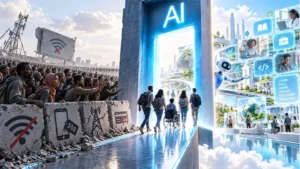

Core takeaway: The assembly line as we know it—a linear sequence of human workers performing repetitive tasks—is being dismantled by embodied AI, humanoid robots, and “lights-out” manufacturing. The global embodied AI for manufacturing market is projected to reach $40.1 billion by 2036 from $2.4 billion in 2026, a 32.5% CAGR. This is not automation as usual. It is the end of the assembly line paradigm.
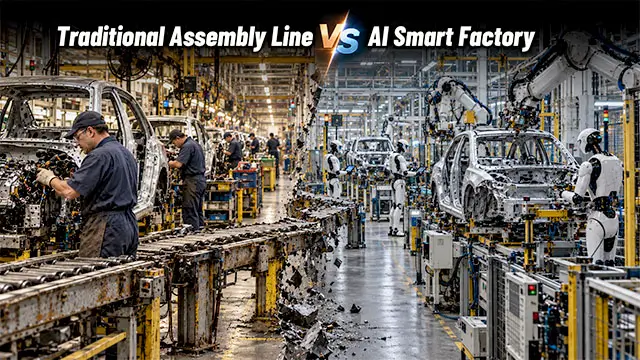
The Rise of the Dark Factory
The most visible sign of this shift is the “dark factory”—a facility where robots operate with lights off and humans largely absent. In Beijing, Xiaomi’s Changping Smart Factory runs almost entirely without manual intervention, with robots assembling components and AI systems correcting errors in real time. At Chinese EV maker Zeekr, robots work in dimly lit zones where “the lights can theoretically be turned off”. Germany’s Frankfurter Allgemeine Zeitung warned that Europe risks missing this industrial transformation entirely, noting that when labor costs become negligible, production shifts not to low-wage countries but to places with stable energy and integrated supply chains.
From Pre-Programmed to Adaptive
What distinguishes this wave from previous automation is embodied AI: robots that perceive, reason, and act rather than follow fixed scripts. At BMW’s Spartanburg plant, Figure AI’s Figure 03 humanoid robots now sort unsorted components from large containers onto sequencing trolleys—the first deployment of a humanoid in a logistics workflow at any BMW facility worldwide. The deployment followed an 11-month pilot in which Figure 02 supported production of over 30,000 X3 vehicles.
The technology has moved beyond controlled trials. At a tablet manufacturing workshop in Nanchang, China, AgiBot’s Genie G2 humanoid robots completed an eight-hour live-streamed shift performing precision quality inspections. Field data showed each operation took 18 to 20 seconds, processing 310 units per hour with a success rate exceeding 99.9%. AgiBot’s senior vice president Yao Maoqing stated: “Embodied intelligence is no longer a lab concept, but a genuine driver of productivity”.
The Human Cost
The workforce implications are profound. Research from MIT and Boston University indicates that AI-driven robotics will have replaced approximately 2 million manufacturing workers globally by 2026. Yet the picture is not uniformly grim. The World Economic Forum’s Human-Machine Collaboration Framework, analyzing over 80 industrial jobs, finds that three in four are expected to evolve rather than disappear, with roughly 40% of future industrial skills classified as new or emerging. AI tutoring technologies have demonstrated upskilling acceleration of approximately 57% and productivity gains of 28–54%.
Selective Autonomy, Not Full Replacement
Fully autonomous factories remain rare. Most manufacturers are adopting what researchers call “selective autonomy,” smoothly switching between human-aware collaboration modes and fully automatic operation depending on the task. The future is not a binary choice between humans and machines. It is a redefinition of what “assembly line” even means—and who, or what, stands on it.