
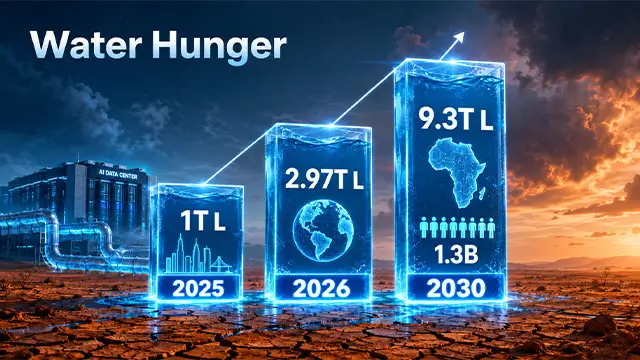
Core takeaway: Big Tech’s data centers consumed nearly 1 trillion liters of water in North America alone in 2025 — enough to meet New York City’s entire annual demand — and the AI boom is accelerating this thirst in regions already running dry. Data centers are expected to gulp down 9.3 trillion liters of water annually by 2030—enough to quench the domestic thirst of all 1.3 billion sub-Saharan Africans, jumping from this year’s estimated 2.97 trillion liters.
The Numbers Are Staggering
Amazon disclosed for the first time in June 2026 that its global data center operations withdrew 2.5 billion gallons (9.5 billion liters) of water in 2025. Google consumed 10.9 billion gallons — a 34% increase from 2024 — with almost all of it going to data-center cooling. Microsoft, which last fully disclosed its water consumption in 2022 at 1.69 billion gallons, has since shifted aggressively toward low-water cooling systems. Across North America, data centers used nearly 1 trillion liters of water in 2025. A single 1 MW data center can consume more than 25 million liters of water each year, placing the sector among the world’s top ten most water-intensive commercial industries.
Where Data Centers Are Built Matters
About one-quarter of existing data centers are located in regions projected to face greater water scarcity by 2050. In the U.S., an analysis found that roughly two-thirds of planned data centers are sited in areas that experienced drought in the past year. In Phoenix, a “severely water-stressed region”, annual water use from data center electricity demand is expected to increase by 400% in coming years. In Virginia’s “data center alley,” large facilities already consume up to 5 million gallons of water per day. As one researcher put it, water is fundamentally local — what is replenished in one watershed cannot offset what is drained in another.
The Hidden Water Footprint
The water these companies report is only part of the story. Indirect water consumption — the water used to generate the electricity that powers data centers — has historically been about 12 times as great as direct consumption, according to a 2024 analysis by Lawrence Berkeley National Laboratory. Google consumes roughly three times as much water indirectly as directly. Yet no U.S. law requires companies to report the full scope of their water use, both direct and indirect.
The Industry Response
Tech giants are scrambling to respond. Microsoft has reduced its water-use intensity from 2.3 liters per kilowatt-hour in the early 2000s to 0.27 L/kWh in 2025 — an improvement of nearly 90%. Approximately 90% of its owned fleet now operates on low to zero-water cooling systems. In June 2026, Microsoft claimed to have achieved “water positivity” in fiscal year 2025, replenishing more water than it withdrew across its global operations.
Amazon, which reports a water efficiency of 0.12 liters per kilowatt-hour — seven times better than the industry average— says it is 75% of the way toward its goal of becoming water positive by 2030. Google has pledged to replenish more water than its data centers consume by 2030 and reported replenishing over 7 billion gallons in 2025 through 165 projects across 97 watersheds.
The Critics’ Case
But critics remain skeptical. Google’s replenishment projects may not always occur in the same stressed watersheds where it withdraws water. “Water positivity” claims have drawn sharp scrutiny — one analysis noted that while Google reported replenishing 7.7 billion gallons in 2025, it remains unclear whether those replenishments happened in the same water-stressed basins where consumption occurred. As one observer noted, “water is fundamentally local” — replenishment in Michigan cannot offset depletion in Nevada. OpenAI CEO Sam Altman has dismissed concerns about AI data centers consuming water as “insane”, yet communities from Virginia to Arizona are increasingly pushing back against new data center construction, citing water use alongside rising power prices and local pollution.
The bottom line is this: data centers are not just consuming electricity — they are drinking water at an unprecedented scale. And in a warming world where drought is becoming the new normal, that thirst is colliding with the most basic human need.