
Core Takeaway: As generative AI produces everything from marketing visuals to software code at scale, one question has become unavoidable: who actually owns the output? The answer varies by jurisdiction — and it is not the one most users expect.
The Human Authorship Principle
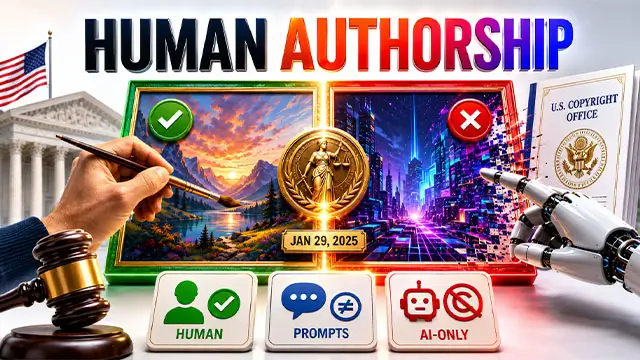
In the United States, the foundational rule is clear: copyright requires a human author. On January 29, 2025, the U.S. Copyright Office released Part 2 of its Copyright and Artificial Intelligence report, concluding that “copyright protection in the US requires human authorship, and therefore, copyright does not extend to purely AI-generated material”. The Office further clarified that “a work that includes AI-generated material will be copyrightable to the extent that human contributions to the work qualify as authorship” — but mere provision of prompts is not enough. Register of Copyrights Shira Perlmutter stated: “Where that creativity is expressed through the use of AI systems, it continues to enjoy protection. Extending protection to material whose expressive elements are determined by a machine, however, would undermine rather than further the constitutional goals of copyright”.
The courts have reinforced this position. On March 18, 2025, the D.C. Circuit affirmed in Thaler v. Perlmutter that the Copyright Act requires works to be “authored in the first instance by a human being”. The Supreme Court denied certiorari on March 2, 2026, leaving the principle beyond dispute. However, the court acknowledged it did not address “how much human involvement is sufficient to support a copyright claim for AI-assisted works” — a question now pending in Allen v. Perlmutter, where an artist used over 600 iterative prompts with Midjourney.
Global Divergence
Other jurisdictions are charting different paths. On March 7, 2025, China’s Changshu People’s Court ruled that AI-generated images can be protected by copyright where the creator’s “crafting of their prompt and subsequent modification of the image reflected their unique choices and arrangement”. Deputy Director Hu Yue of the court’s Intellectual Property Tribunal commented: “The premise for AI-generated content to be recognized as a work is that it should be able to reflect the original intellectual input of a human”.
In the European Union, works completely generated by AI are not protected by copyright, as they lack human intervention and originality. The EU’s originality standard, established in CJEU case law such as Infopaq and Painer, requires discernible human creative choices.
The Training Data Problem
Ownership of output is only half the issue. The other half is whether training AI models on copyrighted material constitutes infringement. In November 2025, the UK High Court largely dismissed Getty Images’ copyright claims against Stability AI, finding that an AI model’s weights are not “infringing copies”, because the model “did not store training data”. The ruling left unresolved whether the training itself is infringement.
Meanwhile, in September 2025, Anthropic agreed to pay $1.5 billion to settle a class-action lawsuit by authors who accused the company of using millions of pirated books to train its Claude chatbot. And in June 2025, Disney and Universal sued Midjourney, alleging “large-scale, willful copyright infringement”.
Practical Takeaways
For businesses using generative AI, the legal landscape demands careful documentation of human creative contributions. Simply pressing “generate” is unlikely to produce copyrightable output. Companies should maintain records of prompts, iterative revisions, curation decisions, and post-generation creative choices — these may become critical evidence in ownership disputes. The AI copyright wars are far from over, but one thing is clear: in the eyes of the law, creativity still begins with a human.