

Core takeaway: Morgan Stanley’s rapid-fire revisions—from 14,000 to 28,000 to 50,000 units in half a year—capture a genuine acceleration in China’s humanoid robot deployment, but the bank’s own analysts now warn that the industry’s biggest obstacle may be public perception rather than technical capability.
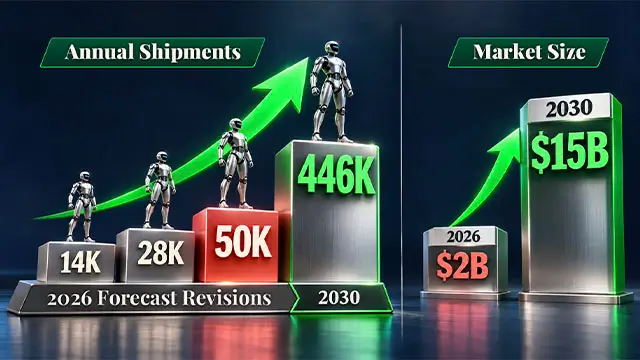
The Forecast Trajectory
In January 2026, Morgan Stanley projected that China would ship 14,000 humanoid robots for the year. By spring, it had doubled that estimate to 28,000. In late June, the bank doubled it again, lifting its 2026 China shipment forecast to 50,000 units—nearly triple its original January figure. The revision was driven by what Morgan Stanley equity analyst Sheng Zhong described as “commercial verification, policy support, and supply-chain feedback” pointing to faster adoption than previously modeled. The bank also estimates China’s humanoid robot market at $2 billion this year, growing to $15 billion by 2030, with annual shipments reaching 446,000 units by that point. The forecast counts only external sales, excluding prototypes, trial units, and internal corporate use.
Why the Numbers Moved
The upgrades track observable deployment rather than speculative demand. China’s Ministry of Industry and Information Technology reported that production exceeded 40,000 units in the first half of 2026 alone, with full-year output expected to surpass 100,000 units. Agibot, the global shipment leader, delivered its 15,000th humanoid robot by late June—less than three months after its 10,000th unit. Counterpoint Research recorded global humanoid shipments above 22,000 units in H1 2026, a nearly 300% year-on-year increase, with Chinese vendors taking the top five spots and 86% of the market. The policy layer reinforces the trend: Beijing has made “embodied AI” a five-year priority, directing local governments to subsidize startups and ordering banks to extend favorable lending terms.
The Headwind Morgan Stanley Now Flags
The forecast revision was not accompanied by unqualified optimism. In a July note, Morgan Stanley analysts argued that humanoid robots face a “PR problem” that could constrain deployment regardless of technical readiness. “Even before any meaningful deployment, humanoids are often framed publicly—by both investors and companies—as direct substitutes for workers rather than tools for hazardous, repetitive or labor-constrained tasks,” they wrote. “The industry’s social license to deploy may matter just as much as technical performance”. The bank also noted that investors have become “harder to impress with polished videos and one-off demonstrations,” increasingly demanding tangible evidence of real-world return on investment, while commercial adoption remains “narrow” and “early”. Despite these caveats, Morgan Stanley retained its 50,000-unit target for the year.
What the 50,000 Number Actually Tests
The forecast’s significance lies less in the precise figure than in what it forces the industry to demonstrate. Shipping 50,000 units would require Chinese manufacturers to move beyond pilot projects and entertainment deployments into sustained industrial and service use—the shift Counterpoint identifies as the next phase of demand growth. It would also test whether the “social license” Morgan Stanley describes can be secured: whether factories, warehouses, and retail operators can integrate humanoids without triggering the worker-replacement narrative that the bank warns is already shaping public and regulatory responses. The number is a bet on deployment, not on engineering. Whether it holds will depend as much on how the industry tells its story as on how many robots leave the factory floor.