

Core Takeaway: The agent economy is here. AI agents can now autonomously book flights, order groceries, and pay bills on your behalf, moving beyond simple chat to real‑world action. Enabled by tools like OpenAI’s Operator and Google’s Project Mariner, this new paradigm promises massive convenience and efficiency. Forecasts suggest agent‑driven transactions could surpass $1 trillion by 2028, but concerns about security, trust, and regulation remain critical.
What Is the Agent Economy?
The agent economy refers to a digital ecosystem in which AI agents—software programs capable of autonomous decision‑making and action—carry out tasks that previously required direct human involvement. Unlike chatbots that merely answer questions, these agents can navigate websites, compare prices, fill out forms, and even authorize payments. They act as personal digital concierges, turning the internet into a hands‑free service layer.
Real‑World Applications: Booking, Shopping, and Bill Pay
The shift from theory to practice accelerated in early 2025 when OpenAI launched Operator, a consumer‑facing agent that can browse the web, click buttons, and complete multi‑step tasks on services like Expedia, Instacart, and OpenTable. A user can simply say, “Find me the cheapest flight to Chicago next Tuesday and book it,” and Operator handles the rest, asking for confirmation before finalizing payment. Around the same time, Google introduced Project Mariner, an experimental Gemini‑powered agent that can fill shopping carts and execute web tasks, signaling Big Tech’s serious commitment to autonomous assistants.
Travel booking, grocery ordering, and bill payment are among the first consumer use cases. Instead of juggling multiple tabs to compare prices, an agent can scan hundreds of options and purchase the optimal one. For routine expenses like utilities or subscriptions, agents can be programmed to pay on time every month, eliminating late fees and mental load.
A Trillion‑Dollar Opportunity
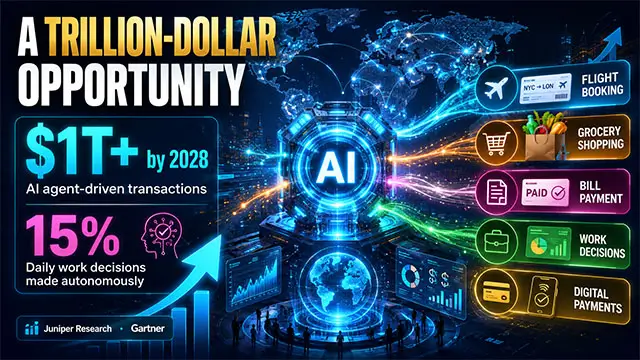
The commercial potential is enormous. Juniper Research forecasts that AI agent‑driven transactions will surpass $1 trillion globally by 2028, fueled by both consumer adoption and enterprise automation. Gartner predicts that by the same year, 15% of day‑to‑day work decisions will be made autonomously by AI agents, a trend that extends naturally into personal finance and household management.
Trust, Security, and Regulation
Giving an AI access to your credit card or bank account raises inevitable concerns. A misaligned instruction or a prompt injection attack could lead to unauthorized purchases. The U.S. Consumer Financial Protection Bureau has emphasized the need for transparency and accountability in AI‑driven financial tools. Meanwhile, the European Union’s AI Act classifies certain autonomous systems as high‑risk, mandating rigorous safeguards. As Bill Gates wrote in a 2023 blog post, “Agents will change how everyone interacts with computers… but we need to ensure they operate safely and in our best interest.”
The Road Ahead
The agent economy is taking shape rapidly. As tech giants refine their platforms and startups innovate, the boundary between digital convenience and delegated autonomy blurs. The ultimate success of this transformation hinges on building trust—through robust security, ethical design, and clear regulation. The future of everyday transactions is not just digital; it’s agent‑driven, and it’s arriving faster than expected.