

Core Takeaway: Tungsten holds the highest melting point of any metal at 3,422°C, yet its glass-like brittleness at room temperature has historically made it nearly impossible to 3D print. In 2026, three independent research breakthroughs — AI-guided alloy design at Carnegie Mellon, grain-boundary topology engineering at multiple institutions, and 5 kW electron beam powder bed fusion — have collectively solved the cracking problem. These advances unlock transformative applications in rocket nozzles, fusion reactor walls, hypersonic vehicles, and next-generation energy systems, with the global 3D printing tungsten powder market projected to grow from $118.8 million to $685.2 million by 2034.
Why Tungsten Is Both Miracle and Nightmare?
Tungsten is an overachiever among metals. It has the highest melting point of any non-alloyed metal at 3,422 degrees Celsius, making it ideal for extreme environments like fusion reactors and rocket engines. Its exceptional thermal conductivity, radiation resistance, and low tritium retention have made it the leading candidate for plasma-facing components in fusion reactors such as ITER.
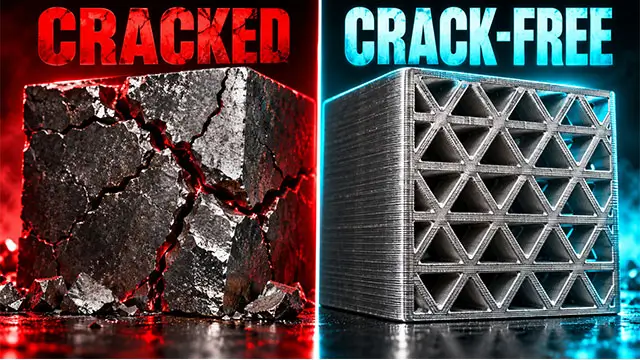
But tungsten has a serious weakness: it is brittle like glass at room temperature. The high ductile-to-brittle transition temperature (around 873 K) leads to susceptibility to cracking and severely limits manufacturability. When used in additive manufacturing, tungsten shrinks and cracks during cooling. Conventional powder-based techniques like hot isostatic pressing and metal injection molding cannot produce complex shapes with internal features, preventing full exploitation of tungsten’s potential.
The AI-Guided Breakthrough
Researchers at Carnegie Mellon University turned to machine learning interatomic potentials (MLIPs) to accelerate the search for tungsten alloys that resist cracking. These models map atomic structures and are 10,000 times faster than physics-based simulations, delivering highly accurate predictions of new atomic configurations. After MLIPs narrowed the best potential alloys, the team applied Density Functional Theory to study elastic properties at the atomic level. When they 3D printed the alloys, two specific “recipes” using different concentrations of tungsten, tantalum, and niobium performed well without cracking. The addition of these elements caused a 50-60% jump in ductility, with tantalum playing a larger role than niobium.
Engineering Grain Boundaries to Stop Cracks
A complementary approach published in Materials Today demonstrated that grain-boundary topology engineering can produce crack-free tungsten without extreme preheating or alloying. By using multi-cycle local rescanning in laser powder bed fusion, researchers progressively reconstructed straight solidification grain boundaries into a tortuous network rich in large-angle triple junctions. These triple junctions act as potent crack arrestors, promoting crack-tip blunting and dislocation-mediated plasticity. The resulting tungsten exhibits full density, complete crack suppression, and mechanical properties comparable to wrought material.
Electron Beam Fusion: Pure Tungsten at Scale
High-power electron beam powder bed fusion has emerged as the most reliable route to pure tungsten components. A 2026 study demonstrated that a 5 kW electron beam with localized heating strategies achieved near-full density (99.9%) in tungsten samples with scan speeds up to 4,200 mm/s, eliminating cracks entirely. The Freemelt ONE machine has become a key platform for this approach, with process optimization achieving densities exceeding 99.9% for critical applications including hypersonic leading edges, armor-piercing penetrators, and rocket nozzle components.
Aerospace: Rocket Nozzles and Hypersonic Vehicles
Tungsten’s combination of high melting point, thermal conductivity, and radiation resistance makes it ideal for aerospace applications including rocket nozzles, ion propulsion jets, and heat sinks. In 2026, a hypersonic test vehicle fabricated in tungsten was designed and built in just five months using AI tools and 3D printing — a process that would normally take two years. The U.S. Department of Energy has also ramped up research into tungsten additive manufacturing for plasma-facing components, breeder blankets, and thermal/radiation shields in fusion reactors.
Energy: Fusion Reactors and the Tungsten-Copper Barrier
The most ambitious energy application is nuclear fusion. Researchers at the University of Nottingham, working with the UK Atomic Energy Authority, have developed a multi-metal laser powder bed fusion technique that simultaneously prints tungsten and copper — two metals with radically different thermal properties that traditional manufacturing cannot join. The DIADEM project creates smooth transitions between tungsten and copper, eliminating weak seams that lead to component failure. This supports the UK’s STEP prototype fusion plant planned for 2040.
The Market Response
The global 3D printing tungsten powder market is projected to grow from $118.83 million in 2025 to $685.15 million by 2034, at a CAGR of 21.49%. Aerospace and defense represent the leading application segment, driven by demand for high-performance components that cannot be produced through conventional means.
Conclusion
Tungsten 3D printing has crossed from laboratory curiosity to industrial capability. The convergence of AI-driven alloy discovery, grain boundary engineering, and high-power electron beam processing has solved the cracking problem that blocked progress for decades. Aerospace and energy stand to benefit first — but the deeper significance is that the hardest metal on Earth is now printable, and the designs that follow will push engineering into environments previously beyond reach.