
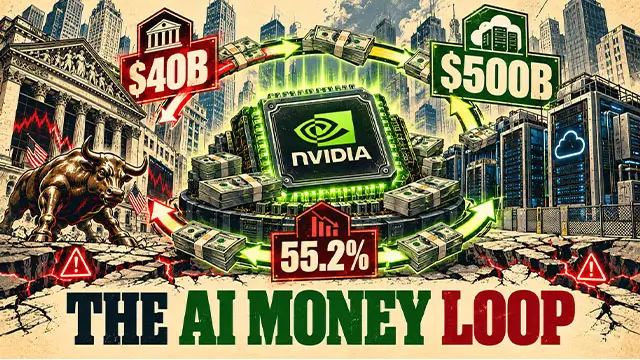
Core Takeaway: Nvidia has committed over $40 billion to AI equity investments in 2026 alone, while arranging $500 billion in financing from six major U.S. financial institutions for its own customers. One central bank analysis found that 55.2% of investments into AI firms came from other AI firms. This circular architecture—where the same companies act as supplier, investor, and customer—has revived dot-com-era warnings and drawn formal scrutiny from the Bank for International Settlements, even as Nvidia’s CEO insists the arrangements reflect genuine demand rather than financial engineering.
The Circular Money Machine
Nvidia has invested up to $10 billion in Anthropic, committed $30 billion to OpenAI, and bought $2 billion of shares in cloud provider CoreWeave. In total, the chipmaker made more than 50 different investment deals in AI companies in 2024 alone, and has already committed over $40 billion to equity investments in 2026. The pattern is consistent: Nvidia invests in a customer, the customer spends the money on Nvidia chips, and both report growth. As The Conversation summarized it, Nvidia becomes “your supplier, your investor and your customer all at once”.
The Ohio Backstop
The most striking example came in August 2026, when Nvidia agreed to provide a guarantee of up to $105 billion to help OpenAI lease a sprawling data center in Ohio developed by SoftBank-owned SB Energy. Nvidia CEO Jensen Huang pushed back firmly against the circular financing label, arguing that OpenAI would pay the rent and that Nvidia was simply using “its scale and long-term visibility” to help secure data centers and power supplies for the decades ahead. Jim Cramer was less convinced. “What we learned in 2000 is you shouldn’t lend money to a company that buys your merchandise,” he said, noting that Nvidia shares fell more than 4 percent when the discussions first surfaced.
Wall Street’s Securitization Pipeline
The financial plumbing extends far beyond Nvidia’s balance sheet. In August 2026, Nvidia partnered with Apollo Global Management, BlackRock, Blackstone, and other Wall Street giants to build a $500 billion securitized financing system for AI chips. The mechanism relies on special purpose vehicles (SPVs): the SPV raises funds by issuing debt, purchases Nvidia hardware, and leases the equipment to end customers. Those lease payments are then packaged into asset-backed securities and sold to institutional investors—a structure one analyst described as “similar to mortgage-backed securities”. Blackstone alone is in discussions to raise at least $360 billion for a second major AI debt financing to fund Anthropic’s use of Google TPU chips.
Why the Alarms Are Sounding
The Bank for International Settlements warned in its 2026 annual report that the current surge in AI investment spending could end in a stock market crash and recession, drawing direct parallels to canal construction in the 1830s, British railways in the 1840s, and the dot-com boom of the late 1990s. The BIS specifically flagged circular financing deals that blend equity, debt, and supplier-client contracts, warning that the terms are often poorly disclosed and carry risks of the same asset being pledged multiple times. Ray Dalio called the situation a “classic bubble,” while Macquarie’s Viktor Shvets argued the AI boom will unwind not in a single crash but through a series of “rolling bubbles” as different segments heat up and cool down.
Not Everyone Is Convinced It’s 2000 Again
The bears have a strong case, but the data cuts both ways. AI-related investment is running at approximately $850 billion in 2026, yet annualized AI revenues are estimated at close to $175 billion—enough to cover current operating expenses and depreciation. Adoption is also running ahead of typical bubble patterns, with a $2 trillion contract backlog visible in hard orders rather than speculative projections alone. Paul Tudor Jones has argued the AI bull market still has one to two years of upside, and Polymarket traders assigned only a 6.1 percent chance of a bubble burst in 2026.
Conclusion
The exotic money pipeline is real: SPVs, backstops, vendor financing, and securitized chip leases have woven the AI ecosystem into a tightly coupled financial web. Whether this represents the foundation of a genuine technological revolution or the architectural blueprint of the next major correction depends on a single variable that no financial engineering can guarantee—whether end-user demand for AI continues to grow fast enough to service the debt that built the infrastructure. As Brian Mulberry of Zacks put it, “The real risk is total AI exposure with no diversification”.