

Core Takeaway: The 2026 Nobel Prize in Physics, awarded to Francis Halzen for founding the IceCube Neutrino Observatory and detecting high-energy neutrinos of astrophysical origin, marks a turning point in astronomy. After centuries of observing the cosmos exclusively through photons—light across the electromagnetic spectrum—scientists now possess a second messenger capable of penetrating regions of space that remain permanently opaque to traditional telescopes. Neutrino astronomy, though still in its infancy, has already traced particles back to a distant blazar and produced the first neutrino image of the Milky Way, and planned upgrades will increase detection rates by an order of magnitude, transforming how humanity perceives the universe.
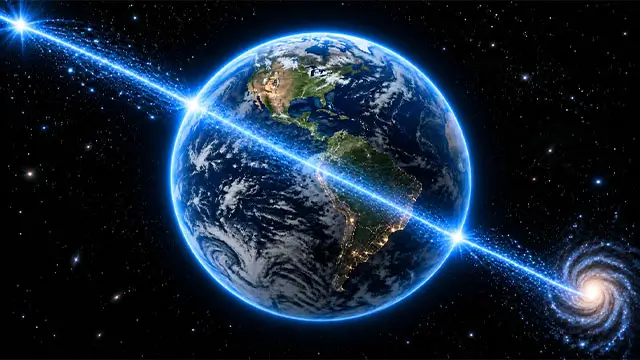
The Limits of Light-Based Astronomy
For most of scientific history, every observation of the cosmos relied on photons. From visible light to radio waves, X-rays, and gamma rays, electromagnetic radiation has been the sole medium through which astronomers could study distant objects. Yet photons face fundamental constraints. They are absorbed, scattered, and deflected by intervening matter. Dense regions of galaxies, the cores of stars, and the environments surrounding supermassive black holes remain hidden because light simply cannot escape them. As Halzen himself noted, neutrinos offer a unique advantage: they can travel through objects, “so maybe you could see things in the universe you couldn’t see any other way”.
What Makes Neutrinos Different
Neutrinos are the second most abundant particle in the universe, after photons. More than one billion pass through a human hand every second. Yet they are extraordinarily difficult to detect because they are unaffected by magnetic fields and rarely interact with matter. This ghostly nature, however, is precisely what makes them invaluable. Because neutrinos pass straight through matter, they provide a straight line back to their source. Because they carry no electric charge, magnetic fields do not bend their paths through space, meaning their arrival direction points directly back toward their origin. Where photons are blocked, neutrinos escape.
IceCube: A Telescope Made of Ice
Detecting these particles required an audacious engineering vision. Halzen’s solution was to embed thousands of light sensors on cables drilled more than 1.5 kilometers into the crystal-clear ice of the South Pole. Completed in 2011 at a cost of $271 million and funded by the U.S. National Science Foundation, IceCube now involves more than 450 researchers. When a high-energy neutrino strikes an atomic nucleus in the ice, it produces charged particles that emit a faint blue glow, which the sensors capture. The pattern and timing of that light reveal both the neutrino’s energy and its direction of arrival. Oftentimes called “ghost particles,” neutrinos exist in great quantities but normally pass straight through Earth undetected.
Milestones That Proved the Concept
IceCube’s first landmark discovery came in 2013, when the collaboration reported the observation of 28 very high-energy particle events—the first solid evidence for astrophysical neutrinos from cosmic accelerators. These neutrinos had more than a million times the energy of those previously detected. Then in 2018, scientists traced a single high-energy neutrino back to a flaring blazar, a supermassive black hole-powered source approximately four billion light-years away. This marked the first time a neutrino had been linked to a specific cosmic object. In 2023, IceCube produced the first-ever neutrino-based image of the Milky Way, revealing our galaxy in a completely new way.
Multi-Messenger Astronomy: A New Paradigm
These breakthroughs helped establish the field of multi-messenger astronomy, which combines observations using different cosmic messengers—electromagnetic radiation, gravitational waves, neutrinos, and cosmic rays—to study the universe. Neutrinos are generated alongside gamma rays in the decays of pions produced when cosmic rays interact with matter or radiation fields. By detecting neutrinos in coincidence with photons or gravitational waves, researchers can build a far more complete picture of violent cosmic events than any single messenger could provide. Halzen has said that opening a new window on the universe often leads to unexpected discoveries, and for neutrino astronomy, “that window may only have begun to open”.
The Future: IceCube-Gen2 and Beyond
The next generation of neutrino telescopes promises to transform the field from one of rare detections into a routine observational science. IceCube-Gen2 will expand the instrumented volume of the optical array by a factor of eight, increasing sensitivity to point sources fivefold and boosting the annual rate of cosmic neutrino observations by an order of magnitude. A new radio array will push sensitivity for ultra-high-energy neutrinos beyond current capabilities. As NSF Director Brian Stone noted, “Foundational science and discovery requires extraordinary human grit” from the engineers and field crews who operate an observatory a mile beneath the Antarctic ice.
The shift from photons to neutrinos represents more than an incremental advance. It is a fundamental expansion of the human sensorium—a new way of perceiving the universe that complements and transcends what light alone can reveal. The ghost particles have begun to speak, and the scientific community is only starting to listen.