

core takeaway: Agentic commerce means an AI agent finds a product, compares options, and completes checkout on a shopper’s behalf, and it moved from demo to live merchant traffic in 2026. The convenience is real, but the new liability question is harder: when an agent buys the wrong thing, nobody in the chain is obviously responsible.
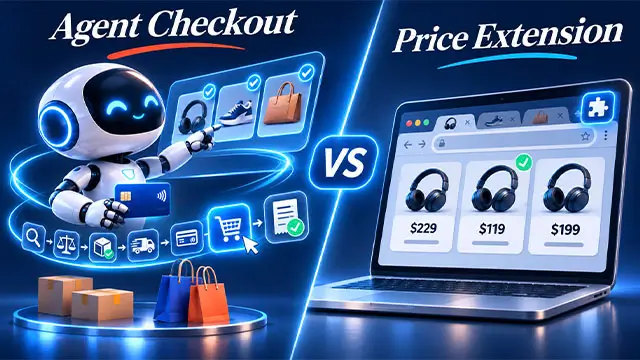
What Separates an Agent Checkout From a Price Extension?
Browser extensions compare tabs a person already opened. A commerce agent acts: it searches across merchants, compares stock and shipping, applies a saved payment credential, and closes the order without waiting for a click. Google introduced the Agent Payments Protocol in September 2025 with card networks, wallets, and merchant partners, giving that handoff a signed receipt (Google, 2025). OpenAI went the other direction with Instant Checkout inside chat. The distinction that matters is authorization: extensions read a page, while agents spend money.
Where Agent Checkout Is Gaining Traction?
The rollout splits along familiar lines. In the United States, agents arrive inside consumer products — chat assistants, shopping apps, card-issued agent credentials — with merchants opting in one category at a time. In the EU, regulation sets the pace first: PSD2 authentication rules, the incoming PSD3 framework, and AI Act transparency duties that reached general-purpose systems in August 2025 (European Commission, 2025). European rollouts are narrower and better documented; American ones ship faster and explain less. Analysts at McKinsey expect agent-mediated buying to grow fastest in repeat categories such as groceries and household staples (McKinsey, 2025).
The Trust Problem: Fraud, Returns, and Blame
The honest limitation is liability. A compromised agent credential behaves like a stolen card with no cardholder to question, and chargeback rules were written for humans, not software. Returns get messier still: when an agent buys the wrong size or the wrong model, the merchant sees a routine order while the shopper sees a mistake they never consciously made. Protocols answer with scoped, expiring tokens and a signed record of what the agent was permitted to do. Only a handful of merchants publish agent-specific return policies, so most disputes fall back on existing consumer law rather than new rules.
How Shoppers Can Spot a Reliable Agent?
Shoppers need two pieces of visible proof before letting software pay. The first is a spend limit they set themselves, shown back at approval instead of buried in settings. The second is a receipt naming the merchant, the item, and the authorization behind the purchase, so a wrong order traces to a specific instruction. Agents that skip either step are running on trust the shopper never granted. One practical test: ask the agent to cancel an order mid-flight and watch whether it reports honestly.
What Merchants Should Check Before Enabling Agents
Three checks matter before turning on agent checkout. First, confirm the token is scoped: one purchase, a spend cap, a short expiry, never a standing credential. Second, insist on an auditable trail naming the agent, the authorization, and the timestamp; without it, dispute resolution is guesswork. Third, publish an agent-specific return path, because a policy written for humans does not tell a bot where to send a wrong item. Merchants that skip the third check usually absorb the returns cost themselves.
Final Thought
Agentic commerce will spread because the friction it removes — search, comparison, forms — is the tedious part of buying online. The merchants and networks that win will be the ones making authorization legible, not the ones moving the most agent traffic this quarter. Convenience scales quickly; trust scales slowly.