
Core Takeaway: AI agents in the workplace are simultaneously tools that automate tasks, teammates that augment human capabilities, and a potential threat to certain jobs. The reality depends on how organizations deploy them, yet the consensus among experts is that AI will transform rather than eliminate most roles—provided workers are reskilled and ethical guardrails are in place.
AI as a Tool: Automating the Routine
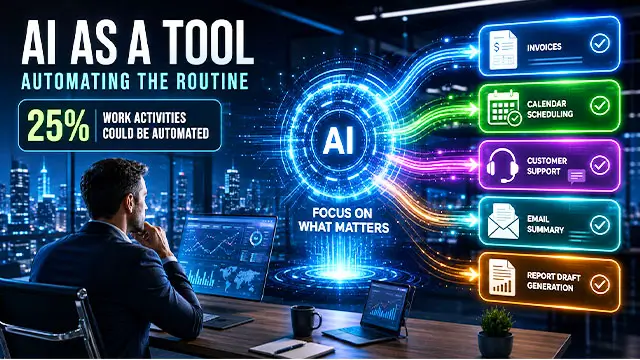
The most immediate and least controversial role of AI agents is as a sophisticated tool. They excel at automating repetitive, rule-based tasks: processing invoices, scheduling meetings, answering routine customer inquiries, or generating first draft reports. According to a McKinsey Global Institute report, current generative AI and other automation technologies could fully automate about 25% of work activities across all occupations, freeing up employees for higher value work. Tools like Microsoft 365 Copilot and Salesforce’s Einstein GPT are already embedded in everyday workflows, summarizing email threads and drafting presentations in seconds. In this sense, AI is no different from the spreadsheet or the search engine—a productivity multiplier that handles the drudgery.
AI as a Teammate: Collaborating, Not Replacing
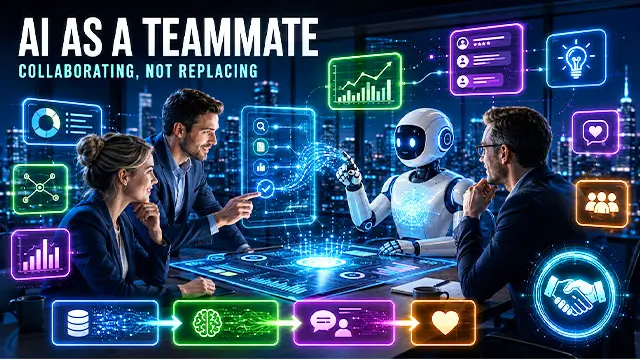
A more transformative vision positions AI agents as digital teammates. Unlike passive tools, these systems can manage multi step projects, proactively suggest actions, and learn from feedback. Harvard Business Review has described AI as a “collaborative partner” that can help teams make better decisions by surfacing insights from vast datasets that humans cannot process alone. For example, in customer service, an AI agent can analyze a caller’s tone and history, suggest responses to a human agent in real time, and even autonomously resolve low complexity issues—handing off to the human only when empathy or judgment is needed. A Stanford University study found that human AI teams outperformed either humans or AI alone on complex diagnostic tasks. This model keeps the human in the loop while leveraging AI’s speed and scale, turning the technology into a force multiplier rather than a replacement.
AI as a Threat: Displacement and Deskilling
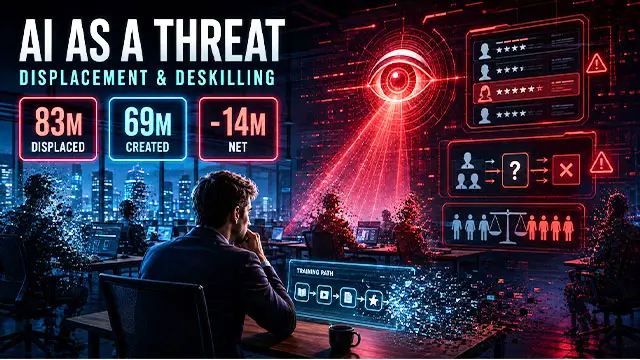
The most anxiety inducing framing is AI as a threat. The World Economic Forum’s Future of Jobs Report 2023 predicts that while AI and automation will displace 83 million jobs globally by 2027, they are expected to create 69 million new ones—a net loss of 14 million. Roles involving data entry, telemarketing, and basic writing are already contracting. Beyond job loss, there is a subtler risk of deskilling: junior employees may lose opportunities to learn foundational tasks if AI handles them entirely. There is also the danger of algorithmic bias and opaque decision-making eroding trust. The OECD has warned that without proper governance; AI could widen inequality and amplify workplace surveillance.
The Way Forward: Embrace the Hybrid Model
The most productive path treats AI agents as both tool and teammate while actively mitigating the threats. Accenture research indicates that companies that adopt a “human centric” AI strategy achieve 2.6 times higher revenue growth. Reskilling programs, transparent algorithms, and clear human oversight are essential. As Erik Brynjolfsson, Director of the Stanford Digital Economy Lab, has emphasized, “The key is not to replace humans but to redesign work so that people can do what they do best, and machines do what they do best.” In the end, whether AI is a teammate, tool, or threat depends less on the technology itself and more on the choices leaders make today.