

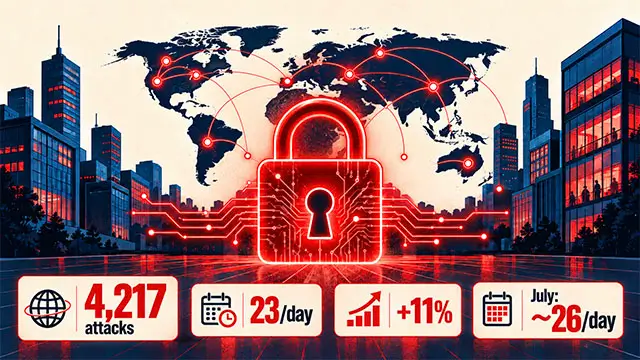
Core Takeaway: In 2026, ransomware surged to unprecedented levels, with 4,217 attacks recorded globally during the first half of the year—roughly 23 per day and an 11% rise from the prior six-month period. The threat escalated further in July 2026, when attacks approached 26 per day, the year’s second-highest monthly total.
The 2026 Ransomware Landscape: A Record-Breaking Year
Ransomware has reached new heights in 2026. During the first half of the year alone, researchers logged 4,217 ransomware attacks globally — an average of 23 attacks per day and an 11 percent increase over the previous six-month period. July 2026 saw that figure climb further, with nearly 26 attacks per day, the second-highest monthly total of the year.
Hospitals Under Siege
Healthcare providers recorded 410 ransomware attacks in the first half of 2026, a 14 percent increase from the second half of 2025, averaging 2.3 attacks per day worldwide. In July alone, attacks on healthcare providers rose another 18 percent, jumping from 45 to 53 incidents.
The consequences are severe. When the University of Mississippi Medical Center was attacked in February 2026, computer systems were crippled and clinics shut down for nine days before operations could resume. Nippon Medical School Musashi Kosugi Hospital in Japan confirmed that 131,700 people were affected by a February attack, while Puerto Rico’s Hospital Caribbean Medical Center began notifying 92,000 individuals about a breach involving healthcare data.
Schools and Universities: An Expanding Attack Surface
Education remained the most targeted sector in June 2026, with organizations facing an average of 4,816 weekly attacks — a 16 percent climb from the previous year. Sophos’s State of Ransomware in Education 2026 report found that identity-based techniques, including phishing, stolen credentials, and brute-force attacks, were involved in 85 percent of ransomware incidents against educational institutions.
The impact on schools is financially devastating. Average ransomware recovery costs in education reached $2.26 million, exceeding the $1.7 million cross-sector average. More than a quarter of education institutions required one to three months to fully recover.
Why Hospitals Are Prime Targets
Four converging factors make healthcare an especially attractive target. First, the stakes are uniquely high — a ransomware attack on a hospital does not merely disrupt business operations, it can directly threaten patient safety. Cybercriminals understand that a health system facing life-or-death consequences is far more likely to pay quickly. Second, the volume and sensitivity of healthcare data — protected health information, Social Security numbers, insurance details — makes hospitals a goldmine for threat actors. Third, the complexity and interconnectedness of healthcare IT environments create numerous potential access points through vendors and partners. Fourth, healthcare has historically underinvested in cybersecurity relative to sectors like financial services.
Why Schools Are Prime Targets
Education institutions face a different but equally dangerous set of vulnerabilities. They support large, frequently changing populations — students, faculty, administrators, temporary workers, researchers, and outside partners — connecting from personal devices, shared computers, and remote locations. Tight access restrictions often conflict with teaching and research requirements. Meanwhile, schools retain student, family, and health data for years by law, creating vast repositories of sensitive information that threat actors can monetize.
According to Ross McKerchar, chief information security officer at Sophos: “Education institutions remain attractive targets because they hold vast amounts of personal data while operating under significant resource constraints. Today’s attackers don’t need a crowbar when they can steal the keys. Identity compromise has become one of the most effective paths into an organization, and AI is only increasing the speed, scale and sophistication of these attacks”.
The AI Acceleration Factor
Artificial intelligence has fundamentally shifted the ransomware threat landscape. According to Fortinet‘s 2026 Global Threat Landscape Report, AI-fueled cyber-attacks have surged by 389 percent, significantly accelerating attack speeds. Attackers now use generative AI to scan for vulnerabilities, draft convincing spear-phishing campaigns, and rewrite malware code on the fly to evade detection. Ransomware groups like Qilin actively harvest credentials stored in browsers, terminate critical system processes, and even reboot infected servers in Safe Mode to bypass security software.
What Effective Defense Looks Like
Despite the escalating threat, organizations can take concrete steps to protect themselves. Phishing-resistant multifactor authentication for privileged users should be the starting point. Zero-trust principles and structured identity management practices help replace broad network access with narrower, role-based permissions. Tested offline backups that are isolated from routine administrative access remain the safest route to recovery.
The U.S. Cybersecurity and Infrastructure Security Agency (CISA), FBI, and Department of Health and Human Services have issued updated joint advisories urging organizations to keep operating systems current, prioritize patching known exploited vulnerabilities on internet-facing systems, and maintain immutable backups stored offline.
Conclusion
Ransomware attacks on hospitals and schools are not opportunistic crimes — they represent calculated market decisions driven by the reality that healthcare cannot absorb downtime and education cannot easily lock down open environments. As AI tools accelerate attack speed and sophistication, the organizations that will weather this storm are those that treat identity as a core security control, implement tested recovery plans, and recognize that cyber resilience is as essential as the care they provide and the education they deliver.