
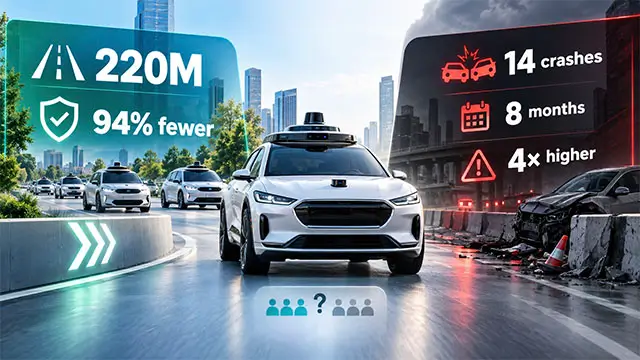
Core takeaway: Driverless cars are no longer a thought experiment. Waymo has logged over 220 million fully autonomous miles through March 2026 and claims a 94% reduction in serious-injury crashes compared to human drivers. But Tesla’s robotaxi fleet has recorded 14 crashes in eight months — a rate over four times that of human-driven cars. The technology works. The question is whether the industry can prove it fast enough to earn public trust.
Waymo’s Safety Record: The Numbers Speak
Waymo’s latest safety analysis, covering more than 220 million fully autonomous miles through March 2026 — the equivalent of over 250 human lifetimes behind the wheel — paints a compelling picture. Compared to human drivers in the same areas and over the same period, the Waymo Driver was involved in 94% fewer crashes causing serious or fatal injuries, 82% fewer airbag-deployment crashes, and 82% fewer crashes involving any reported injury.
These findings are not confined to Waymo’s own reporting. In July 2026, the Insurance Institute for Highway Safety (IIHS) published the first independent, large-scale safety analysis of robotaxis. Based on approximately 50 million driverless miles, Waymo’s crash involvement rate was 68% lower than that of human drivers — 76% lower in Phoenix, 71% lower in Los Angeles, and 35% lower in San Francisco. Waymo vehicles were involved in 85% fewer single-vehicle crashes and 81% fewer injury crashes per vehicle mile traveled.
“The results show that, on a limited scale, these driverless cars are safer than human drivers — who can be impaired or drowsy or suffer lapses in attention,” said IIHS President David Harkey.
Tesla’s Divergent Path
Tesla’s approach to autonomous driving tells a different story. In May 2026, the company released 17 detailed crash reports to NHTSA, covering incidents between July 2025 and March 2026. The vast majority involved only property damage — 13 of 17 incidents — with two involving no injuries and only one resulting in a mild hospitalization.
However, the crashes reveal real limitations. In at least two cases, teleoperators — remote human drivers — took control of the vehicles and subsequently crashed them into barriers. In one incident in January 2026, a safety monitor requested navigation assistance, and the remote operator drove the vehicle into a construction barricade.
More troubling is the crash rate. Analysis of Tesla’s robotaxi data shows the fleet recorded one crash every 57,000 miles — over four times the rate for human-driven cars. Tesla’s total active fleet remains small, with only 14 vehicles operating unsupervised in Austin as of mid-2026.
Regulatory Momentum
U.S. regulators are accelerating the path to deployment. In June 2026, NHTSA proposed removing the requirement for hand and foot operated brake controls in vehicles designed exclusively for autonomous operation — a significant regulatory shift for purpose built robotaxis. In September 2026, the Department of Transportation released its AV 5.0 national strategy, outlining a framework for automated vehicle deployment and insurance.
The Trust Gap
Public perception remains deeply divided. A June 2026 TaskUs survey found that 38% of Americans are likely to try a robotaxi in the next 12 months, yet only 35% believe robotaxis are safer than human drivers, while 38% consider them less safe. The single biggest barrier is not technology but access: consumers who live in cities with robotaxi services are nearly six times more likely to trust them than those who do not.
The Bottom Line
The data is increasingly clear: at scale, Waymo’s robotaxis are demonstrably safer than human drivers. IIHS President Harkey put it bluntly: “The present data collection system isn’t good enough to allow continuous monitoring of a large-scale expansion”. The technology works. The challenge now is scaling it safely — and proving it to a skeptical public.