
Core Takeaway: The artificial intelligence revolution has uncovered a fundamental truth: memory bandwidth, not compute power, is the binding constraint on AI performance. AI accelerators spend more time waiting for data to move between memory and processing cores than performing calculations themselves. The technology solving this bottleneck—High-Bandwidth Memory (HBM)—has become the most strategically consequential component in the AI silicon stack.
A Market Exploding Beyond Expectations
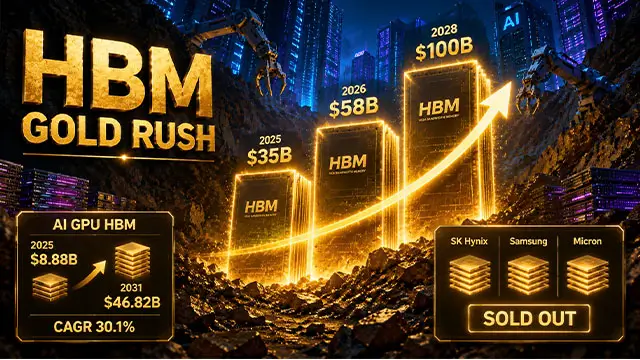
The numbers tell a dramatic story. The HBM market alone reached an estimated $35 billion in 2025 and is projected to approach $58 billion in 2026, with all three suppliers—SK Hynix, Samsung, and Micron—fully sold out. The HBM for AI GPUs market is expected to grow from $8.88 billion in 2025 to $46.82 billion by 2031, at a CAGR of 30.10%. Some estimates place the total HBM market on a trajectory toward $100 billion by 2028. This isn’t just growth—it’s a gold rush.
The Technology Leap: From HBM3E to HBM4
Each new generation of AI accelerator demands more HBM per chip. The transition from HBM3E to HBM4 represents the largest bandwidth leap in HBM history. SK Hynix’s HBM4 delivers over 2 TB/s bandwidth with 48GB capacity per stack—60% faster than HBM3E. The interface doubles from 1,024 bits to 2,048 bits. Samsung is already pushing further, targeting HBM4e with 13 Gbps per-pin speeds delivering 3.25 TB/s—about 2.5 times faster than current HBM3E.
The Oligopoly: Three Players Control the Supply
Only three companies supply qualified HBM at scale: SK Hynix, Samsung, and Micron. SK Hynix dominates with roughly 53–62% market share. Samsung rebounded to second place with 22% in Q3 2025, overtaking Micron‘s 21%. This oligopoly structure enables premium pricing and pricing is soaring.
The Cost Crisis: HBM Eats AI Chips Alive
HBM’s strategic importance is matched only by its cost impact. For NVIDIA’s B200 GPU, the 192GB HBM3E memory alone costs $2,800–$3,100—nearly half the total bill of materials and exceeding the GPU logic itself. HBM4 pricing has climbed to approximately $560 per chip, a 50% increase over HBM3E’s $370. HBM4 now accounts for 25% of NVIDIA’s next-generation GPU costs, up from 18% in the HBM3E era. NVIDIA has responded by raising AI chip prices by 15% to pass on some of this burden.
Supply Cannot Keep Pace
The supply-demand imbalance is severe. SK Hynix’s entire 2026 HBM capacity is already sold out, with orders booked through Q1 2027 and core clients locked in until end 2027. Industry sits at just four weeks—an extreme tight-balance state where chips ship as soon as they are produced. Deutsche Bank analysts project HBM demand will grow at roughly 40% CAGR through 2030, while supply gaps cannot be closed before 2027.
Why HBM Is the New Gold
HBM has transformed from a commodity DRAM product into the gating factor for the entire AI infrastructure. It consumes approximately three times the wafer area of equivalent DDR5 capacity, crowding out consumer memory supply. Advanced packaging—not logic dies—emerged as the primary bottleneck on AI chip production in 2025. With demand exploding, supply tightly controlled by three players, and pricing power firmly in suppliers’ hands, HBM has become the most precious resource in the AI economy. In the race to build intelligence, memory is the new gold—and whoever controls HBM controls the future of AI.