

Core Takeaway: Collaborative robots, or cobots, are transforming manufacturing by working safely alongside humans without the need for heavy cages or complex programming. Unlike traditional industrial robots designed for high speed, isolated tasks, cobots are flexible, affordable, and easy to redeploy. According to the International Federation of Robotics (IFR), cobot installations are growing faster than any other robot segment, and by 2026 they will account for a substantial share of all new industrial robot deployments. The result is a factory floor where automation is no longer limited to large enterprises but is accessible to small and medium-sized manufacturers as well.
What Makes a Cobot Different?
Traditional industrial robots are built for raw speed and heavy payloads. To protect workers, they are typically fenced off in safety cells. Cobots, by contrast, are designed for direct human interaction. They are equipped with force limiting sensors, rounded edges, and vision systems that allow them to slow down or stop when a person enters their workspace. This makes them ideal for tasks where human judgment and machine precision need to coexist, such as assembly, quality inspection, and machine tending.
ISO/TS 15066 defines the safety requirements for collaborative robot applications, giving manufacturers a clear framework for deployment. This standard has helped accelerate adoption by reducing the complexity of risk assessments. As a result, cobots can often be installed in days rather than months, and workers can be trained to operate them in hours instead of weeks.
Market Growth and Economic Impact
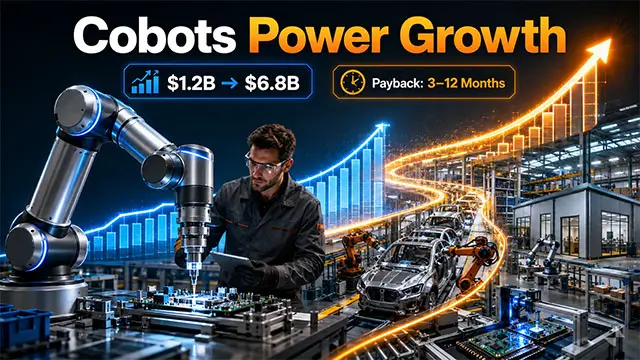
The global collaborative robot market has expanded rapidly. According to MarketsandMarkets, the cobot market was valued at approximately $1.2 billion in 2023 and is projected to reach $6.8 billion by 2028, a compound annual growth rate of over 40%. The IFR reports that cobot installations grew by double digits in 2023, outpacing traditional industrial robots in percentage terms. Electronics and automotive sectors lead adoption, but the fastest growth is now coming from small and medium enterprises that previously could not justify automation.
The economic appeal is simple: cobots lower the entry barrier. Universal Robots, the market pioneer, notes that the average payback period for a cobot is less than 12 months, and some applications pay for themselves in as little as 3 to 6 months. This has made cobots particularly attractive in regions with rising labor costs and shrinking workforces.
Real World Applications
On the factory floor, cobots are used for a widening range of tasks. In electronics assembly, they handle delicate components with consistent precision. In packaging and palletizing, they take over repetitive, ergonomically stressful motions that cause worker injuries. Machine tending—loading and unloading CNC machines—is one of the most popular applications, as it allows one worker to oversee multiple machines simultaneously.
Quality inspection is another growth area. Cobots equipped with cameras and AI vision systems can detect microscopic defects far more reliably than the human eye. This combination of AI and physical robotics is creating a new class of intelligent assistants that can learn tasks through demonstration rather than code, further simplifying deployment.
Enhancing Workers, Not Replacing Them
One of the most significant misconceptions about cobots is that they take jobs. In practice, they tend to take over the “3 Ds”—dirty, dangerous, and dull tasks—while freeing humans for higher value work. A study by the Massachusetts Institute of Technology (MIT) found that human cobot collaboration can improve overall productivity by up to 85% compared with either humans or robots working alone. This is because cobots handle the repetitive, precise motions, while workers contribute problem solving, dexterity, and adaptability.
Moreover, many manufacturers report that cobot adoption leads to upskilling. Workers become cobot programmers, operators, and maintenance technicians, often earning higher wages. In an era of labor shortages, cobots help companies maintain output without forcing existing employees into unsustainable overtime.
Challenges and the Road Ahead
Cobots are not without limitations. They typically move slower and handle lighter payloads than traditional robots, which makes them unsuitable for heavy manufacturing. Safety standards, while helpful, still require careful application to each unique workspace. Integration with existing systems can also be complex, particularly for older factories with no digital infrastructure.
Nevertheless, the trajectory is clear. As AI, vision, and force sensing technologies continue to advance, cobots will become even more capable and intuitive. The factory floor of the future will not be a human free zone; it will be a collaborative space where people and machines each do what they do best. That is the quiet revolution cobots are bringing to manufacturing today.