

Core Takeaway: As the artificial intelligence revolution accelerates, NVIDIA stands at the epicenter of a high-stakes race to build the world’s most powerful AI superchips. With competitors AMD, Intel, and Broadcom closing in, NVIDIA’s next move will determine whether it retains its iron grip on the AI infrastructure market—or cedes ground to a resurgent field.
The Superchip Dynasty
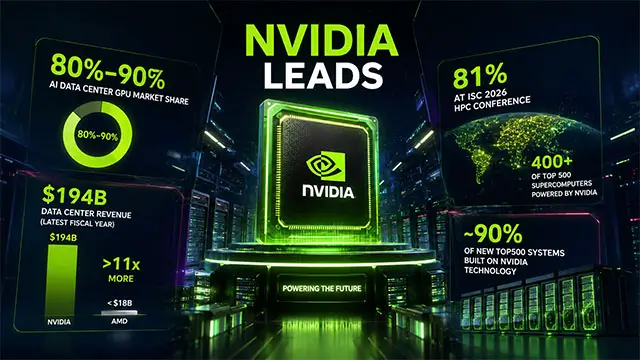
NVIDIA’s dominance in AI hardware is virtually unchallenged. The company controls approximately 80% to 90% of the AI data center GPU market, with its data center segment generating roughly $194 billion in its most recent fiscal year—more than 11 times AMD’s entire data center business. At the ISC 2026 High-Performance Computing conference, NVIDIA technology powered over 400 of the world’s 500 fastest supercomputers, capturing 81% market share. Nearly 90% of new TOP500 systems are built on NVIDIA technology.
The Next Frontier: Vera Rubin and Beyond
NVIDIA’s immediate next move centers on the Vera Rubin platform, which has already entered full production. Unveiled as the successor to the Grace Blackwell superchip family, Vera Rubin combines Rubin GPUs with Vera CPUs and is expected to deliver computing speeds 3.3 times faster than the current Blackwell Ultra generation. The platform is slated for general availability in the second half of 2026. Meanwhile, Blackwell-based systems—including GB200 and B200 configurations—have already made their debut in the TOP500 supercomputer ranking. According to TrendForce, Blackwell solutions will account for 71% of NVIDIA’s high-end GPU shipments in 2026, further cementing its market dominance.
The company has also signaled strategic expansion through acquisitions. NVIDIA is reportedly paying approximately $20 billion for non-exclusive access to Groq’s AI inference chip technology, aiming to strengthen its position in the fast-growing inference segment.
The Competitive Landscape
Despite NVIDIA’s lead, the competitive heat is intensifying. AMD has launched its Helios platform, featuring the Instinct MI455X GPU, Venice CPU, and Pensando networking systems, directly challenging NVIDIA’s Vera Rubin in certain key metrics. AMD’s data center revenue surged 57% year-over-year, and the company has secured multi-year commitments from OpenAI and Meta. However, AMD still holds only a single-digit share of the AI GPU market, and analysts note that NVIDIA’s CUDA software ecosystem—developed over nearly two decades—remains a critical moat that competitors struggle to cross.
Intel, by contrast, has largely sat out the AI accelerator race, with its next-generation data center AI chips not expected until 2027.
The Memory Cost Squeeze
NVIDIA’s next move is also being shaped by external pressures. Soaring memory costs have forced NVIDIA to warn its largest customers of price hikes exceeding 15% on Grace Blackwell and Vera Rubin servers shipping in early 2026. DRAM contract prices surged 90% to 95% in Q1 2026 alone, and with each Rubin GPU packing up to 288GB of HBM4 memory, memory has become one of the largest cost components in AI server production.
The Road Ahead
NVIDIA’s next move is clear: double down on its superchip roadmap while navigating supply chain turbulence and intensifying competition. CEO Jensen Huang has revealed an estimated $1 trillion backlog in AI chip demand through 2027—a staggering figure that underscores the insatiable appetite for AI compute. While AMD gains momentum and geopolitical tensions reshape regional markets, NVIDIA’s combination of hardware performance, software ecosystem, and massive production scale makes it the undisputed king of the AI superchip race—for now. The question is not whether NVIDIA will lead, but how long it can stay ahead.