
Since the launch of ChatGPT, the public conversation around generative AI has often centered on chatbots, image generators, and enterprise automation. Yet behind the scenes, one of the most profound transformations is unfolding in a two-hundred-billion-dollar market: the video games industry. Generative AI is quietly reshaping how games are built, played, and experienced—without the same fanfare, but with arguably deeper long-term impact.
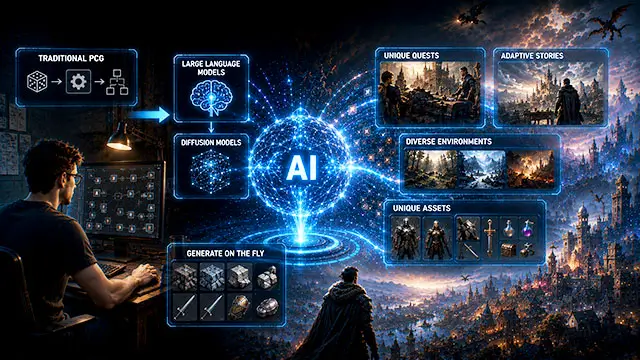
For decades, procedural content generation (PCG) has been used to create randomized levels, loot, and landscapes. However, traditional PCG relies on hand-crafted rules and algorithms, limiting its variety. Generative AI, armed with large language models and diffusion models, takes this to a new level. Developers can now prompt an AI to design a medieval village with a dark backstory, generate unique quests that adapt to player choices, or produce textures and 3D assets on the fly. Generative AI makes that infinite variety feel handcrafted and contextually rich.
Perhaps the most player-facing change is happening with non-player characters (NPCs). Historically, NPCs have been limited to scripted dialogue trees, breaking immersion when they repeat lines. Generative AI now enables NPCs to hold open-ended conversations, remember past interactions, and even exhibit dynamic personalities. Startups and major studios alike are experimenting with AI-driven NPCs that can generate side quests based on a player’s behavior or offer unplanned emotional depth. This turns static worlds into living, reactive ecosystems, making each playthrough genuinely unique.
The development pipeline is also being transformed. Concept artists use generative AI to ideate hundreds of environment sketches in minutes. Programmers leverage code-generation assistants to speed up scripting and debugging. Quality assurance can be augmented by AI agents that simulate thousands of gameplay scenarios far faster than human testers. The result is not the replacement of human talent but an augmentation that lets creative teams focus on high-level design and narrative. Independent developers, in particular, benefit from these tools, levelling the playing field by reducing the cost and time to prototype.
Narrative and personalization are reaching new heights. Generative AI allows for dynamic storytelling where the plot branches reactively, not just to key decisions but to every nuanced action a player takes. A detective game might generate unique case files, clues, and suspect dialogues that never repeat. This adaptive narrative design creates a “just for you” experience, increasing replayability and player engagement, which is a holy grail for game-as-a-service models.
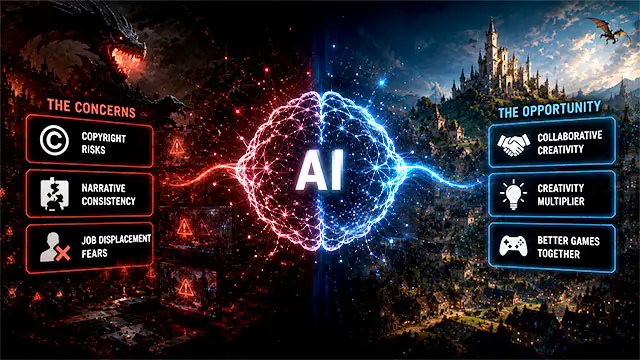
Of course, the silent revolution raises concerns. Copyright issues emerge when training on existing art or code. Maintaining narrative consistency is technically difficult, and some creatives fear job displacement. The industry is actively crafting ethical guidelines, yet most studios see generative AI as a collaborative creativity multiplier, not a replacement.
In conclusion, generative AI is quietly but irrevocably reshaping the video games industry. It is changing the very fabric of game creation, from infinite worlds to meaningful interactions. While still maturing, its footprint is already visible in early-adopter games and developer toolkits. Ignoring this shift would be short-sighted. The game has changed, and generative AI is the new engine under the hood.