
Core Takeaway: The battle between open source and proprietary AI will not produce a single winner. Instead, both models are carving out distinct roles: proprietary systems currently lead in raw performance and safety for high-stakes applications, while open-source drives innovation, lowers costs, and gives organizations control over their data. The future is hybrid, with enterprises increasingly using open models alongside closed APIs, and regulation playing a decisive role in shaping how each evolves.
The Open Source Surge
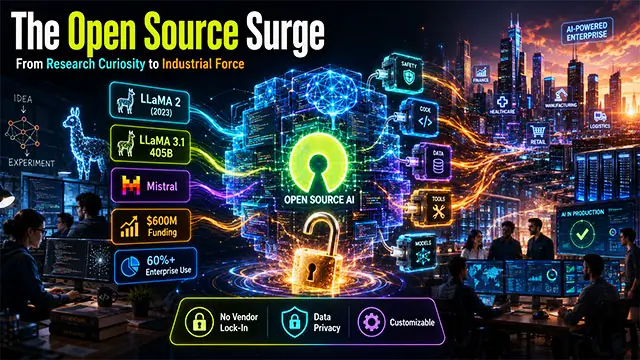
Open source AI has evolved from research curiosity to industrial force. Meta’s LLaMA series ignited a firestorm when the weights for LLaMA 2 were released in 2023, enabling startups and researchers to fine-tune capable models at a fraction of the cost. The release of LLaMA 3.1 405B in mid-2024, which Meta CEO Mark Zuckerberg called “the first frontier-level open-source model,” narrowed the gap with proprietary leaders. French startup Mistral has also proven that lean teams can build highly competitive open models, securing a $600 million funding round in 2024 that valued the company at nearly $6 billion.
The advantages are clear: no vendor lock-in, full data privacy, and the ability to customize models for specific industries. According to a 2024 survey by a16z, over 60% of enterprises are already using open source models in some capacity, with a growing number deploying them in production. The Linux Foundation’s Open Model Initiative, backed by Intel, AMD, and others, further signals that open source AI has deep industry backing.

Proprietary AI’s Enduring Edge
Proprietary models from OpenAI, Google DeepMind, and Anthropic still hold a performance edge on the hardest tasks. GPT-4o, Gemini 1.5 Pro, and Claude 3.5 Sonnet consistently top benchmarks like MMLU-Pro and HumanEval, and they offer multimodal capabilities and agentic features that open models have yet to fully replicate. Importantly, these companies invest heavily in safety research, including red-teaming, reinforcement learning from human feedback (RLHF), and constitutional AI—efforts that a 2024 paper from the Center for AI Safety argues are harder to replicate in decentralized open source projects.
Proprietary APIs also simplify deployment, provide ongoing maintenance, and come with service-level agreements that enterprises find reassuring. For heavily regulated industries such as healthcare, finance, and government, the curated safety of a closed model can be a selling point. OpenAI’s custom models program and Google’s Vertex AI allow large clients to adapt proprietary models while keeping the core inference and safety infrastructure controlled by the vendor.
The Regulatory Wildcard
Regulation may tip the scales. The EU AI Act, passed in 2024, exempts most open source models from its strictest requirements, provided they are not monetized or deployed in high-risk scenarios. This creates a favorable environment for open source development in Europe. In contrast, the U.S. executive order on AI uses the Defense Production Act to compel large proprietary models to undergo safety testing and share results with the government—potentially adding compliance costs that open source projects avoid. How these regulatory tracks evolve could determine which camp attracts the most investment and talent over the next decade.
The Hybrid Reality
The battle’s likely outcome is already visible: a hybrid ecosystem. Enterprises now routinely use proprietary models for the most sensitive or complex work while running open source models for internal tools, research, and cost-sensitive applications. Microsoft’s Azure AI Studio, Google’s Vertex AI, and Amazon’s Bedrock all support both closed and open models side by side. As Andreessen Horowitz noted in its 2024 AI infrastructure report, the real war is not between open and closed, but between commoditized AI capabilities and the applications and data layers built on top of them. Open source ensures AI is a commodity; proprietary AI raises the ceiling on what that commodity can do.
Conclusion
There is no single victor in the open versus proprietary AI contest. Open source democratizes access and fuels grassroot innovation; proprietary AI sets the performance frontier and delivers the safety needed for high-stakes use. Their coexistence is reshaping the industry into a layered landscape where value migrates from raw model capability to the application layer, data integration, and user experience. The future belongs to those who can harness both, building on open foundations while leveraging proprietary breakthroughs where they matter most.