

Core Takeaway: Big Tech companies have made ambitious pledges to go carbon negative, but the explosive energy demands of AI and cloud infrastructure are making those goals harder to reach. Despite massive investments in renewable energy and carbon removal, the question remains whether genuine carbon negativity can be achieved without clever accounting or offsetting schemes that merely shift emissions elsewhere.
The Scope of the Challenge
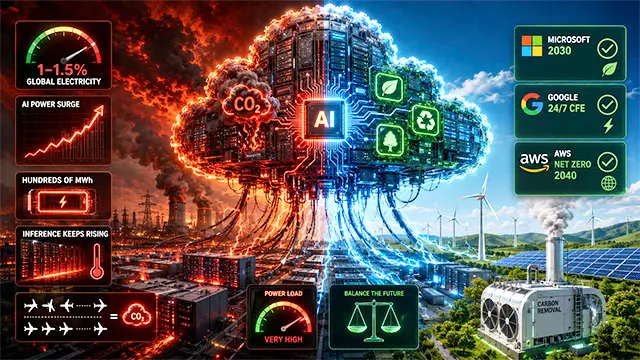
The cloud is anything but weightless. Data centers already consume an estimated 1 to 1.5 percent of global electricity, according to the International Energy Agency. With the rapid adoption of generative AI, those figures are projected to rise sharply. A 2023 analysis by researchers at the University of California, Riverside, found that training a single large language model can consume hundreds of megawatt-hours of electricity and generate carbon dioxide emissions equivalent to several hundred round-trip flights between New York and San Francisco. Inference, the ongoing use of trained models, adds significantly more over time.
This reality sits uneasily alongside ambitious corporate pledges. Microsoft announced in 2020 that it would be carbon negative by 2030 and, by 2050, would remove all the carbon the company has emitted since its founding. Google, which has been carbon neutral since 2007 through offset purchases, has aimed to run on carbon-free energy 24/7 by 2030. Amazon, the world’s largest cloud provider through AWS, has committed to net-zero carbon by 2040 through its Climate Pledge initiative.
Progress and Contradictions
The progress has been real. Google has signed contracts for over 10 gigawatts of renewable energy capacity, and Microsoft has invested heavily in direct air capture technology through partners like Climeworks and Carbon Engineering. AWS reached 90 percent renewable energy across its operations in 2023, several years ahead of its original 2030 target.
However, contradictions have also emerged. A 2023 investigation by The Guardian and Corporate Accountability found that some of the world’s largest tech companies rely on carbon accounting practices that allow them to purchase renewable energy credits while still drawing power from fossil fuel grids. In real terms, this means a data center can claim to be “green” while physically running on coal or gas-fired electricity if it buys enough credits elsewhere.
The AI boom has further complicated the picture. In a 2024 sustainability report, Microsoft acknowledged that its carbon emissions had risen by approximately 30 percent compared to 2020 levels, largely due to the energy demands of expanding AI infrastructure. Google’s 2024 environmental report revealed a 48 percent increase in total emissions over 2019 figures, driven by data center energy consumption and supply chain expansion.
Beyond Offsetting: Carbon Negative or Carbon Accounting?
Carbon negativity implies removing more carbon from the atmosphere than a company emits. This is distinct from “net zero,” which allows for offsetting remaining emissions through purchased credits. True carbon negative status requires permanent, verifiable carbon removal—a far more expensive and technically challenging proposition.
Current offset markets face credibility problems. A 2023 investigation by The Guardian, Die Zeit, and SourceMaterial found that over 90 percent of rainforest carbon credits certified by Verra, the world’s leading carbon standard, were likely “phantom credits” that did not represent genuine emissions reductions. If tech companies rely on similar instruments to meet their goals, the carbon negative label risks becoming more of a marketing exercise than an environmental achievement.

The Critical Role of Scope 3 Emissions
For cloud providers, the majority of emissions fall under Scope 3—indirect emissions from suppliers, customer usage, and product disposal. This makes accounting exceptionally difficult. When a customer uses AWS to deploy an AI model, the energy consumed is counted in Amazon’s Scope 3 inventory. Persuading millions of customers and thousands of suppliers to decarbonize is an entirely different challenge than buying renewable energy for one’s own facilities.
Signs of Genuine Innovation
Despite the challenges, genuine innovation is underway. Google DeepMind has deployed AI to optimize data center cooling systems, reducing energy consumption by up to 30 percent. Microsoft is experimenting with hydrogen fuel cells as backup power for data centers, replacing diesel generators. Companies like Equinix and Digital Realty are exploring liquid cooling technologies that dramatically reduce the energy required to manage server heat. Direct air capture, while still expensive and small-scale, is attracting serious corporate investment and could eventually provide the permanent carbon removal needed for carbon negative claims to hold weight.
Conclusion
Big Tech can point to real achievements in renewable energy procurement and efficiency innovation. However, the rapid growth of AI, the limitations of carbon offsets, and the complexity of Scope 3 emissions mean that the path to genuine carbon negativity remains extremely challenging. The green cloud is not a lie, but it is not yet the full truth either. Whether these companies achieve carbon negativity will depend less on their pledges and more on their willingness to prioritize climate goals alongside the breakneck expansion of artificial intelligence