

Core Takeaway: Brain-computer interfaces are no longer just experimental lab tools. They are already restoring movement and communication for people with severe paralysis, and a new wave of less invasive devices aims to bring BCI benefits to everyday users—for focus, wellness, and even gaming. The leap from medical miracle to everyday enhancement is underway, though significant ethical, safety, and privacy questions remain.
Medical Miracles: Restoring What Was Lost
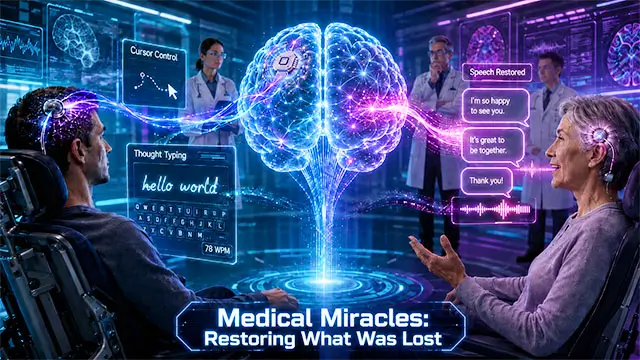
The most striking BCI advances have occurred in healthcare. In 2021, researchers from the BrainGate consortium demonstrated in Nature that a tiny sensor array implanted in the motor cortex enabled a person with tetraplegia to mentally control a computer cursor and type at speeds approaching smartphone texting, using imagined handwriting. Another landmark study from UCSF, published in Nature Medicine in 2023, showed that a speech neuroprosthesis could decode the intended words of a stroke survivor with anarthria at a rate of about 78 words per minute, restoring fluent conversation after years of silence.
Companies are now pushing these breakthroughs toward real-world use. Synchron’s Stentrode device—which is implanted via the jugular vein in a minimally invasive procedure—received FDA breakthrough device designation and has allowed people with ALS to control a computer with their thoughts, no open brain surgery required. Elon Musk’s Neuralink began its first-in-human clinical trial in 2024, implanting a coin-sized device with over a thousand electrodes in a quadriplegic patient. Early reports indicate the patient could play chess on a computer using only neural signals. These are genuinely life-changing applications that were unthinkable a decade ago.
Moving Beyond Disability Toward Enhancement
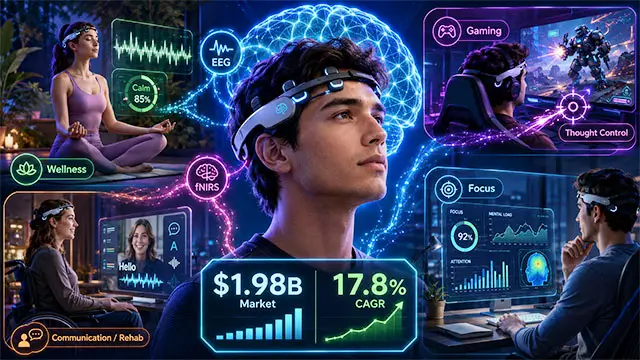
The same foundational technology is now attracting interest from beyond the clinic. Non-invasive BCI devices that use electroencephalography (EEG) or functional near-infrared spectroscopy (fNIRS) are already entering the consumer wellness and productivity market. The Muse headband, for example, guides users through meditation by providing real-time feedback on brain activity patterns, and over 500 peer-reviewed studies have examined its efficacy for stress reduction and focus training.
Startups like NextMind (acquired by Snap) have developed snap-on EEG sensors that let users control simple on-screen actions by visually attending to them, hinting at a future where pinching your fingers in the air could be replaced by a glance and a thought. Kernel, founded by Bryan Johnson, uses fNIRS helmets to measure brain oxygenation and provide insights into cognitive states, with potential applications in brain health and personalized productivity.
Market projections reflect growing commercial ambition. According to a 2023 report by Grand View Research, the global BCI market size was valued at $1.98 billion in 2022 and is expected to expand at a compound annual growth rate of 17.8% from 2023 to 2030, driven largely by non-invasive devices in gaming, communication, and rehabilitation.
The Hard Questions Ahead
As BCI creeps into daily life, it raises profound questions. Implantable BCIs carry surgical risks including infection, bleeding, and device rejection, while even non-invasive headsets collect highly sensitive brain data that could reveal mental health states, cognitive abilities, or even subliminal attitudes. Who owns that data, and how securely is it stored? The European Union’s AI Act and the U.S. Government Accountability Office have both called for updated regulatory frameworks for neurotechnology. Another concern is a “neural divide”—a future where only the wealthy can afford cognitive enhancements, further widening social inequalities.
Conclusion
Brain-computer interfaces are already delivering medical miracles, freeing people from the prison of profound paralysis and giving voice to the voiceless. Their gradual migration into everyday enhancement—whether for meditation, focus, or play—seems inevitable. But whether that evolution is wise, equitable, and safe will depend less on the technology itself than on the choices researchers, companies, and regulators make right now. The next chapter of BCI is being written, and it is as much about ethics as it is about engineering.