

Core Takeaway: Snap has officially unveiled Specs, its first consumer-facing augmented reality glasses, priced at $2,195 with shipments beginning in fall 2026 across the U.S., U.K., and France. The standalone wearable packs dual Snapdragon processors, a 51-degree field-of-view LCoS display, and roughly four hours of mixed-use battery life into a 132-gram frame. The launch positions Snap ahead of Apple and directly against Meta’s market-leading Ray-Ban line, but the steep price and bulky form factor have drawn immediate skepticism from analysts and investors alike.
A Decade in the Making, Finally on Sale
Snap’s journey to consumer AR glasses has been anything but straightforward. The company released three generations of camera-focused Spectacles between 2016 and 2019, none of which achieved mainstream adoption. Specs represents a fundamental departure: rather than a Snapchat accessory, Snap is selling what CEO Evan Spiegel calls “a totally new type of computer” for the face. “Almost 20 years since the launch of the iPhone, people are ready to think about computing differently,” Spiegel told CNBC.
What $2,195 Actually Buys
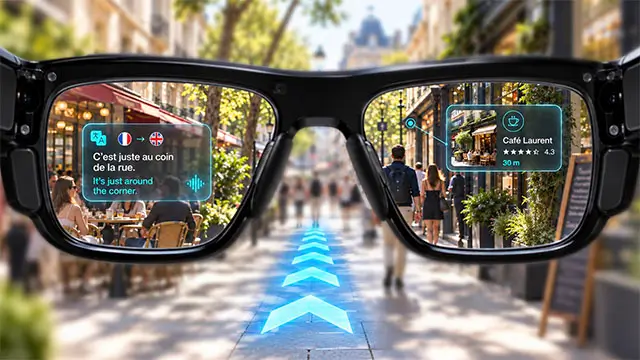
The hardware is undeniably ambitious. Specs are fully standalone—no tethered puck, no paired smartphone—driven by dual Qualcomm Snapdragon chips, with one dedicated to continuous computer vision and the other to running AR Lenses. The proprietary LCoS display delivers a 51-degree diagonal field of view with 16 million colors, which Snap compares to a 115-inch screen viewed from ten feet away. Electrochromic lenses shift from clear to tinted in approximately ten seconds, borrowing technology from Boeing aircraft windows. The frames, made from Swiss TR90 polymer, come in two sizes weighing 132 grams and 136 grams respectively.
Battery life sits at roughly four hours of mixed use, extended to 20 hours with the bundled charging case—a significant improvement over the developer-only predecessor’s 45-minute runtime. Contextual AI is central to the pitch: look at something, ask about it, get an answer. The EyeConnect feature even allows two Specs wearers to trigger shared AR experiences through eye contact alone.
The Verdict: Impressive Tech, Familiar Obstacles
Reactions have been sharply divided. IDTechEx analysts reported that many attendees at the Augmented World Expo expressed disappointment, citing the bulky form factor, four-hour battery life, and low eyepiece transparency as significant barriers to consumer adoption. PCMag’s hands-on noted that CEO Spiegel’s ears appeared visibly bent by the frames, raising questions about comfort during extended wear. Social media commentary was similarly unforgiving, and Snap’s stock fell more than five percent the day after the announcement.
B. Riley analysts maintained a “Neutral” rating, noting that initial demand will likely be held back by the high unit price, though they expect Snap to use the launch to refine future, more affordable versions.
A Two-Lane Market
Forbes frames the emerging smart glasses market as splitting into two distinct philosophies: discreet, everyday AI companions like Meta’s Ray-Ban glasses, which command roughly 70% of the market, versus powerful, immersive spatial computers like Specs. Spiegel has defended the pricing by comparing Specs to a high-end laptop rather than a pair of sunglasses, positioning them for shorter, more intensive sessions rather than all-day wear.
Conclusion
Specs is not a mass-market product, and Snap is not pretending otherwise. It is an early-adopter play that bets on a post-smartphone computing paradigm—one where the screen lives on your face, not in your pocket. Whether that bet pays off depends less on the hardware, which is genuinely capable, and more on whether developers can build experiences compelling enough to justify the price. For now, Snap has beaten Apple and Google to the consumer AR starting line. The race, however, has only just begun.