

Core Takeaway: As defined by SAE International, fully autonomous vehicles (Level 5) will transform car interiors from driver-focused cockpits into versatile living rooms on wheels. Freed from driving, passengers will work, relax, or sleep while traveling. Concepts like the Mercedes-Benz F 015 and Volvo 360c have previewed this future, while McKinsey & Company estimates that autonomy could free up over 50 minutes per day for U.S. drivers, and Intel’s “passenger economy” forecast predicts a $7 trillion global market by 2050. However, the National Highway Traffic Safety Administration has issued only voluntary guidelines, and IHS Markit cautions that Level 5 deployment is unlikely before the mid-2030s—so while the shift is a near-future reality, significant regulatory and technical hurdles remain.
The New Cabin: From Cockpit to Comfort Zone
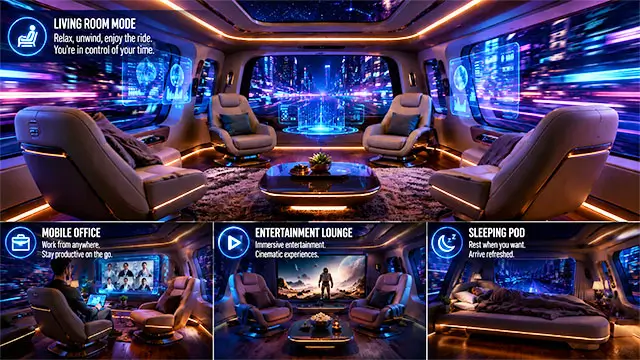
The Society of Automotive Engineers (SAE) defines Level 5 automation as a vehicle that can handle all driving tasks under all conditions without human intervention. Once that threshold is reached, the steering wheel and pedals become optional. Automakers have already previewed this transformation. Mercedes Benz’s F 015 Luxury in Motion concept (2015) featured four rotating lounge chairs, a retractable steering wheel, and gesture controlled displays, explicitly designed as a “digital living space.” Volvo’s 360c concept (2018) went further, showcasing a car interior that could convert into a mobile office, an entertainment room, or a sleeping pod for overnight travel.
These concepts are grounded in a fundamental insight: when drivers become passengers, they reclaim an average of nearly one hour per day spent behind the wheel in many countries. McKinsey & Company estimates that autonomous driving could free up over 50 minutes per day for each driver in the U.S. alone, creating a massive opportunity for new in cabin experiences.
Work, Play, and Rest on the Move
The “passenger economy” is a term coined by Strategy Analytics and Intel, who jointly forecast that autonomous vehicle enabled services could generate $7 trillion globally by 2050. A significant slice of that value will come from productivity and entertainment. Imagine a morning commute spent on a video call with a full size display, or a weekend road trip where the family watches a movie while the car handles the highway. Seats will recline fully for napping, and ambient lighting will adjust to match activities or time of day, much like a modern living room.
Automakers and suppliers are already preparing. BMW’s i Vision Dee concept demonstrated how the windshield can become a full width augmented reality screen for entertainment or information. Panasonic Automotive is developing cabin systems with AI driven mood adaptation. These technologies point toward a future where the vehicle interior becomes as customizable as a home environment.
Safety, Regulation, and the Timeline
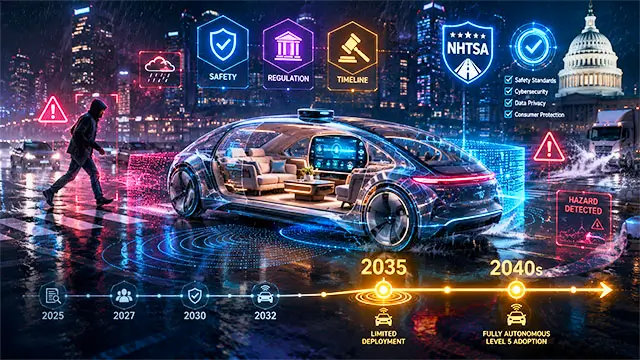
Before cars can fully become living rooms, fundamental safety questions must be answered. Fully autonomous systems must prove they can handle rare and chaotic edge cases—from extreme weather to unpredictable pedestrians. The U.S. National Highway Traffic Safety Administration (NHTSA) has issued voluntary guidelines for automated driving systems, but comprehensive federal legislation remains elusive. According to IHS Markit, fully autonomous vehicles (Level 5) are unlikely to reach meaningful market penetration before 2035, with many analysts predicting the mid 2030s as the earliest deployment window for truly driverless passenger cars. Widespread consumer adoption, consequently, might extend into the 2040s.
Despite these challenges, the direction is clear. As Waymo and Cruise expand their robotaxi services in select cities, they are gathering the real world data necessary to refine the technology and build public trust. Each successful ride is a step toward the moment when your car asks not where you’ll drive, but what you’d like to do while you’re on your way. The living room on wheels is no longer a concept—it’s an industry target slowly coming into view.