
Core Takeaway: Apple’s Vision Pro didn’t invent spatial computing, but it has pushed the technology from niche enterprise use into the consumer spotlight. With intuitive eye-and-hand controls praised by The Verge and Wired, deep ecosystem integration that lets users wirelessly extend a Mac display—an advantage noted by Bloomberg’s Mark Gurman—and a growing library of over 1,000 native visionOS apps, the headset has sparked serious interest across design, medicine, and remote work. Cedars-Sinai Medical Center has tested it for pre-operative surgical planning, and platforms like Microsoft Teams and Zoom have released spatial meeting personas for distributed collaboration. However, its $3,499 price tag, a weight of roughly 600–650 grams that reviewers at The Wall Street Journal found fatiguing in extended use, and the absence of a “killer app” mean that, while the moment of legitimacy has arrived, spatial computing isn’t yet an everyday reality.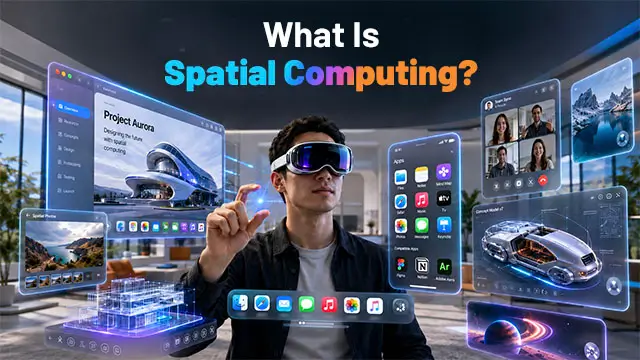
What Is Spatial Computing?
Spatial computing blends digital content with the physical world, allowing users to interact with apps and data through gestures, eye tracking, and voice. Unlike virtual reality, which replaces your surroundings, spatial computing overlays information onto your real environment or seamlessly mixes the two. Microsoft’s HoloLens and Magic Leap explored this terrain years ago, but both remained confined to specialized industrial applications and never achieved broad consumer traction.
Vision Pro’s Immediate Impact
Since its launch in early 2024, Apple’s Vision Pro has generated significant cultural and commercial ripple effects. According to early estimates from market intelligence firm IDC, Apple sold over 200,000 units in the first few weeks—a figure that, while small by iPhone standards, far exceeds typical enterprise headset sales. More importantly, Apple announced that developers had created over 1,000 apps designed specifically for visionOS within months of launch, signaling a healthy—if fledgling—ecosystem.
Key differentiators include:
• Controller-free navigation: Users select items simply by looking at them and pinching their fingers, a gesture system Apple calls “eyes and hands.” This removes a major barrier for non-gamers, as noted by early reviews in The Verge and Wired.
• Spatial video and photos: The ability to capture and relive memories in three dimensions adds an emotional appeal that industrial headsets never prioritized.
• Seamless Apple integration: Vision Pro wirelessly extends a Mac’s display and syncs with iPhones and iPads, making it feel like a natural expansion of the Apple ecosystem rather than a separate gadget.
Real-World Applications Taking Shape
Vision Pro is already being tested in professional settings that hint at spatial computing’s long-term value:
• Design and Architecture: Firms use the headset to visualize life-size 3D building models, allowing teams to spot structural issues before construction begins.
• Medical Training and Planning: Cedars-Sinai Medical Center in Los Angeles has employed Vision Pro for pre-operative planning, where surgeons view patient CT scans as interactive holograms. According to the hospital’s innovation team, this enhances spatial understanding of complex anatomy.
• Remote Collaboration: Enterprise platforms like Microsoft Teams, Zoom, and Webex have released spatial “persona” features, enabling distributed teams to meet around virtual tables and interact with shared 3D content.
Persistent Hurdles to Mass Adoption
Despite the momentum, significant barriers remain:
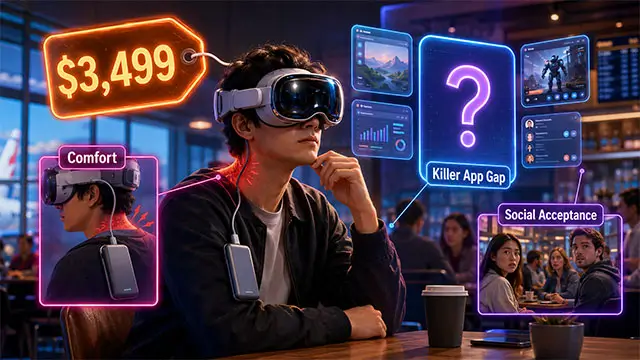
1. Cost: At $3,499, Vision Pro is priced for developers and early adopters. Ming-Chi Kuo, a respected Apple analyst with TF International Securities, forecasts that a more affordable version may not arrive until 2027 or later.
2. Comfort: The headset weighs roughly 600–650 grams, and the separate battery pack adds another 353 grams. Extended sessions can cause noticeable fatigue, as highlighted in multiple hands-on reports.
3. Killer App Gap: While the app count is growing, there’s no single, irresistible experience that compels a broad audience to buy. Productivity tools are promising but not yet transformative for average consumers.
4. Social Acceptance: Wearing a headset on a plane or in a café still draws stares. Cultural normalization, as seen with AirPods, takes years.
Has the Moment Finally Arrived?
“Finally” may be too strong a word. But Apple has undeniably made spatial computing legitimate. Before Vision Pro, the conversation around mixed reality was dominated by Meta’s metaverse push, which many saw as a solution in search of a problem. Apple reframed the narrative: spatial computing isn’t about escaping reality; it’s about enhancing productivity, creativity, and memory.
As analyst Ming-Chi Kuo and others suggest, the current device is a proof of concept—a developer kit for the masses. The true tipping point will come when Apple delivers a lighter, more affordable model and the software library matures. For now, the moment is one of inflection. Apple has planted the flag, developers are building, and early adopters are showing what’s possible. Spatial computing has found its footing, even if it hasn’t yet found its way into every living room.