
Core Takeaway
The AI stock sell-off won’t immediately make laptops cheaper, but cooling AI demand could eventually affect semiconductor prices. For back-to-school shoppers, retailer discounts and choosing the right laptop specs matter far more right now.
If you’re a parent shopping for a laptop before school starts, the latest Wall Street sell-off may seem like someone else’s problem.
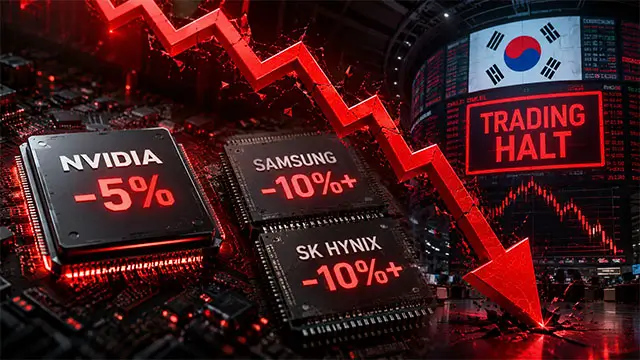
Nvidia shares fall 5%. Samsung and SK Hynix plunge more than 10%. South Korea’s stock market temporarily shuts down trading.
What does any of that have to do with the $600, $800 or $1,000 laptop sitting on your back-to-school shopping list?
More than you might think.
The same AI boom that has pushed semiconductor companies to record valuations has also increased demand for chips, computing equipment and data-center hardware. Now investors are asking whether companies are spending too much money chasing the next AI breakthrough.
At the same time, American families are entering one of the biggest technology-shopping periods of the year.
The National Retail Federation expects U.S. K-12 families to spend a record $43.3 billion on back-to-school purchases in 2026. Electronics alone account for about $14.7 billion, or an average of $293.11 per K-12 shopper. College students and their families are expected to spend another record $103.5 billion, with electronics accounting for $24.63 billion.
So the real question isn’t whether Nvidia’s stock falling 5% will magically make laptops cheaper.
It won’t.
The more interesting question is whether the AI boom—and the sudden doubts surrounding it—could eventually change what consumers pay for computers.
AI Stocks Are Falling, But AI Spending Is Still Exploding
The recent market sell-off follows an extraordinary period for AI investment.Nvidia is the clearest example.
For fiscal 2026, Nvidia reported $215.9 billion in annual revenue, up 65% from the previous year. Its fourth-quarter revenue reached $68.1 billion, while data-center revenue hit $62.3 billion.
Then the growth accelerated again.
For the quarter ended April 26, 2026, Nvidia reported $81.6 billion in revenue, up 85% year over year. Its data-center business generated $75.2 billion, up 92%.
Those numbers explain why investors became so excited about AI.
But they also explain the new concern.
Companies are spending enormous amounts of money building AI infrastructure. The question is whether the profits eventually generated by AI will be large enough to justify that spending.
That is the uncomfortable question behind the stock-market sell-off.
Semiconductor Stocks Are the Hidden Link to Your Laptop
Here’s where the Wall Street story reaches your shopping cart.
AI doesn’t run on magic. It runs on semiconductors, memory, processors, networking equipment, storage and enormous amounts of electricity.
Nvidia supplies the specialized processors powering many AI data centers. Samsung Electronics and SK Hynix are major players in memory chips.
When investors become worried about future AI demand, semiconductor stocks can get hit particularly hard.
That’s what happened in the market move described by the BBC: Nvidia fell 5% in New York, while Samsung Electronics and SK Hynix both dropped more than 10%. South Korea’s Kospi fell sharply enough to trigger a temporary circuit breaker.
But there’s an important distinction:
A falling chip stock does not immediately mean a cheaper laptop.
The price of a laptop depends on far more than the stock price of the companies making its components.
It depends on chip supply, memory prices, manufacturing costs, exchange rates, retailer margins, competition, promotions and—perhaps most importantly during back-to-school season—how badly retailers want your business.
Back-to-School Shopping Is Already a Price War
This is where things get interesting for families.
The NRF says 78% of back-to-school shoppers expect prices to be higher this year. At the same time, about one-third say they typically plan their purchases around summer sales.
And shoppers are actively waiting for discounts.
Among consumers who had not purchased at least half of their back-to-school items, 46% said they were waiting for the best deals, while 23% said they were spreading their budgets out. Another 47% said they planned to buy only the essentials initially and replenish supplies later.
That matters more to your laptop budget than Nvidia’s one-day stock movement.
Retail competition is already producing substantial discounts.
Current back-to-school listings show examples such as a $649.99 Asus Vivobook 16, marked $150 below its comparable value, while some entry-level HP laptops have been listed below $200. Higher-end Copilot+ PCs have also been discounted heavily.
In other words, you don’t necessarily need a semiconductor crash to find a laptop deal.
You need competition between retailers.
Laptop Deals May Matter More Than the AI Stock Market
This is probably the most useful takeaway for parents.
If you’re buying a laptop this August, don’t wait for Nvidia to fall another 5%.
Watch the retailers.
The current market already shows a wide range of prices. A basic HP laptop has appeared around $190, while a more capable Asus Vivobook with 16GB of memory and a 1TB SSD has been listed around $650. Premium Copilot+ machines can still cost more than $1,000, even when discounted.
That means the biggest savings may come from choosing the right specification rather than trying to predict semiconductor prices.
For a student who mainly needs:
- Google Docs or Microsoft Office
- web browsing
- video calls
- school portals
- presentations
- streaming
a midrange laptop may be enough.
A student doing engineering, computer science, video editing, 3D work or AI development may have a very different set of requirements.
The most expensive laptop isn’t automatically the best value.
Do You Really Need an AI PC for School?
This may be the biggest question hiding behind the AI boom.
Laptop manufacturers increasingly market machines around terms such as AI PC, Copilot+ PC, NPU, and on-device AI.
The technology is real.
But that doesn’t mean every student needs to pay a premium for it.
Ask what the student will actually do with the computer.
If the answer is mostly writing papers, browsing the internet and joining online classes, paying hundreds of dollars extra for specialized AI hardware may not produce hundreds of dollars of additional value.
If the student uses AI tools heavily, edits video, works with large datasets or needs local machine-learning capabilities, the equation changes.
The important point is:
Buy the workload, not the marketing label.
Personal Finance Tip: Don’t Confuse a Stock Dip With a Laptop Sale
This is where investors and consumers need to think differently.
A stock price reflects expectations about a company’s future earnings.
A laptop price reflects the cost of components, manufacturing, distribution and retail competition.
Those worlds are connected—but they’re not synchronized.
Nvidia falling 5% doesn’t mean a $900 laptop suddenly becomes $855.
Even a major decline in semiconductor stocks might take months to affect component contracts, inventories and retail pricing.
And there’s another complication.
If AI demand remains strong, semiconductor companies could continue investing heavily despite short-term stock volatility.
Nvidia’s own numbers show why. Its data-center revenue increased 92% year over year in its latest reported quarter.
So it would be premature to declare that the AI boom is ending simply because investors became nervous.
Consumer Electronics Prices Could Change If AI Spending Cools
There is, however, a scenario worth watching.
Imagine AI companies eventually decide that they don’t need to spend quite as aggressively on new data centers.
Demand for certain chips and components could cool.
Manufacturers might face less pressure for scarce components.
Competition could increase.
Retailers could become more aggressive with discounts.
That could eventually be good news for consumers.
But there is an opposite scenario.
If AI demand keeps growing, chip manufacturers may continue prioritizing the most profitable AI hardware. That could keep parts of the semiconductor supply chain under pressure.
In that case, the AI boom could remain a factor supporting higher prices for certain high-performance components.
So AI stocks down ≠ laptops cheaper.
It’s:
AI investment changes → chip demand changes → component economics change → manufacturers adjust → retailers eventually adjust prices.
That process takes time.
The Best Back-to-School Laptop Strategy Right Now
For families shopping this month, the simplest strategy is probably also the safest.
Don’t try to time Nvidia. Time the retailer.
Compare several stores before buying.
Look for laptops with at least the specifications your student actually needs rather than automatically choosing the newest processor.
Pay attention to RAM and storage, because a slightly older machine with adequate memory and an SSD can provide much better value than a flashy model with a higher marketing price.
And watch the return policy.
A $700 laptop that doesn’t meet your student’s needs isn’t a bargain.
A $500 laptop that comfortably handles four years of schoolwork can be.
The NRF’s data suggests consumers already understand this. About one-third of shoppers plan purchases around summer sales, while many others are waiting for better deals.
So, Will the AI Stock Dip Save You Money?
Probably not directly.
Nvidia’s 5% decline won’t suddenly slash laptop prices. Samsung and SK Hynix shares falling more than 10% won’t automatically turn an $800 computer into a $600 computer.
But the sell-off does reveal something important for consumers.
The AI boom has created enormous demand for computing infrastructure. Nvidia’s latest quarterly data-center revenue of $75.2 billion shows just how large that boom has become.
Now investors are asking whether the financial returns from AI can justify the extraordinary amount of capital being committed to it.
If that spending eventually slows, the effects could travel through the semiconductor supply chain and, over time, influence the cost and availability of consumer electronics.
But you don’t need to wait for that to happen.
With $43.3 billion in expected K-12 back-to-school spending, $14.7 billion of it going toward electronics, the more immediate opportunity is already sitting in front of shoppers.
The biggest back-to-school savings this year may not come from an AI stock crash.
They may come from knowing what you actually need, comparing laptop prices, and refusing to pay extra for AI features your student will never use.
Disclaimer
This article is for general informational purposes only and does not constitute financial, investment, or purchasing advice. Stock markets and consumer electronics prices can change rapidly.