

Core Takeaway: Today’s AI is defined by two simultaneous realities: breathtaking breakthroughs in science, reasoning, and multimodal understanding, and persistent, unsolved flaws in hallucination and bias. Models like GPT 4, AlphaFold, and Gemini can outperform humans on professional exams and predict protein structures, yet they still invent facts with unnerving confidence and amplify societal prejudices. The real state of AI is not a finished product but a raw, extraordinarily powerful tool that must be handled with equal parts ambition and caution.
The Persistent Problem of AI Hallucinations
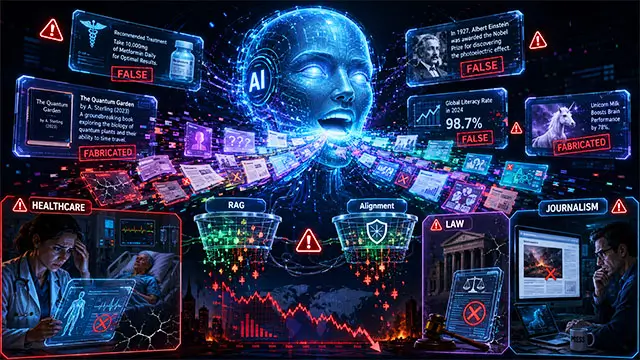
Techniques like retrieval augmented generation (RAG) and tighter alignment are reducing hallucination rates, but no team has eliminated the problem. For high-stakes domains such as law, healthcare, and journalism, this remains a critical barrier to fully autonomous deployment.
Embedded Bias: The Ghost in the Training Data
Bias in AI stems from training data that mirrors centuries of human prejudice. A landmark 2018 study by MIT researcher Joy Buolamwini and Timnit Gebru showed that commercial facial analysis systems had error rates of up to 34% for darker skinned women, compared to under 1% for lighter skinned men. More recent research from Stanford’s Center for Research on Foundation Models found that popular language models associate certain demographics with higher rates of criminality and negative sentiment, even when the text contains no explicit mention of identity.
These biases are not deliberate; they are absorbed from the uneven internet text used in training. Techniques like reinforcement learning from human feedback (RLHF) and constitutional AI have reduced some overt toxicity, but subtler, baked in stereotypes persist. As AI systems increasingly influence hiring, lending, and policing, addressing this “ghost in the data” has become an urgent ethical priority.
The Breakthroughs Driving Genuine Progress
Despite these flaws, the recent crop of AI breakthroughs is genuinely historic.
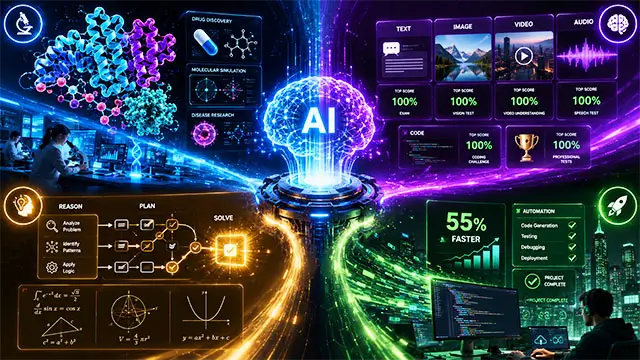
• Scientific discovery: DeepMind’s AlphaFold2 predicted the 3D structure of over 200 million proteins, a feat that the journal Science called the “Breakthrough of the Year” and one that is already accelerating drug discovery and disease research.
• Multimodal mastery: Models like GPT 4o, Gemini 1.5 Pro, and Claude 3 can fluidly reason across text, images, video, and audio, passing bar exams, medical licensing tests, and advanced coding competitions—often in the top percentiles of human performance.
• Reasoning and planning: The introduction of “chain of thought” and models like OpenAI’s o1 series has given AI the ability to break complex problems into logical steps, dramatically improving performance on mathematics and science benchmarks.
• Generative productivity: GitHub Copilot, used by over 1.5 million developers, has been shown in a GitHub commissioned study to help developers complete tasks up to 55% faster, signaling a real near term economic impact.
Navigating the Real State of AI
Today’s AI is neither the magical oracle of hype nor the existential villain of dystopian fiction. It is an engineering marvel with known, catalogued flaws. As the European Union’s AI Act and the U.S. Executive Order on AI signal, governance is racing to catch up with capability. The task for researchers, companies, and governments is to preserve the velocity of breakthroughs while building guardrails that contain hallucinations and correct for bias. The real state of AI, then, is one of extraordinary tension: fragile and fallible, yet undeniably world changing.