
Core Takeaway: Solid-state batteries are widely regarded as the breakthrough that could finally push electric vehicles past lingering consumer concerns about range, charging speed, and safety. By replacing the flammable liquid electrolyte with a solid one, they promise longer range, ultrafast charging, and lower fire risk. Major automakers like Toyota—holder of over 1,300 patents and targeting commercial launch by 2027–2028—along with startups such as QuantumScape, are racing to bring them to market. However, as BloombergNEF cautions, manufacturing complexity and high costs remain the biggest hurdles to mass adoption.
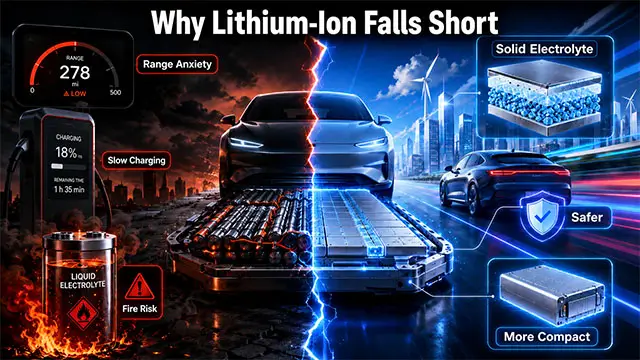
Why Today’s Lithium-Ion Batteries Fall Short?
Current EVs rely on lithium-ion batteries that use a liquid electrolyte to shuttle ions between the anode and cathode. While they have steadily improved, three fundamental limitations persist:
• Range anxiety: Most affordable EVs still struggle to exceed 300 miles of real-world range.
• Slow charging: Fast charging from 10% to 80% typically takes 18–30 minutes, far longer than refueling a gasoline car.
• Safety risks: The flammable liquid electrolyte can overheat and, in rare cases, trigger fires after a crash or manufacturing defect.
Solid-state batteries address all three problems at once by replacing that liquid with a solid electrolyte—often a ceramic, glass, or polymer—that is nonflammable and allows a more compact design.
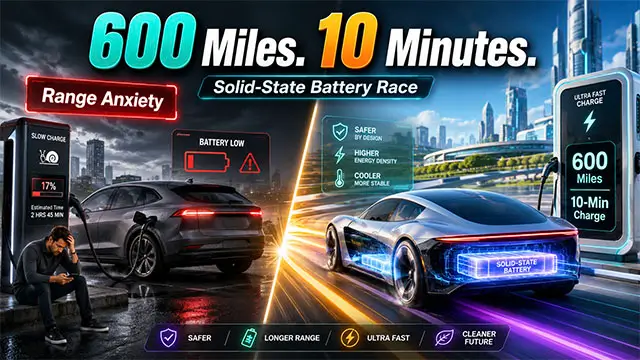
The Promise of Solid-State Technology
Because solid electrolytes are safer and can pair with a lithium metal anode, solid state cells can pack significantly more energy into the same space. Industry estimates point to energy densities of 400–500 Wh/kg, compared to roughly 250–300 Wh/kg for today’s best lithium-ion cells. In practical terms, that could mean an electric sedan that travels 500–600 miles on a single charge while weighing less.
Charging speed is another leap. Toyota, one of the leaders in solid state development, has stated its goal of achieving 10 minute fast charging from 10% to 80%. Solid state designs also perform better in cold weather and degrade more slowly, potentially extending the useful life of a battery pack well beyond current averages.
Who Is Leading the Race?
The solid-state landscape is a mix of automotive giants and well-funded startups:
• Toyota has filed over 1,300 solid state battery patents and plans to introduce the technology in a hybrid vehicle first, with full EVs later this decade.
• Nissan has announced a pilot production line and a target of mass producing solid state batteries by fiscal year 2028.
• Volkswagen has invested heavily in QuantumScape, a Silicon Valley startup that claims its ceramic separator enables 15 minute fast charging at a wide range of temperatures.
• BMW and Ford are backing Solid Power, which uses a sulfide based electrolyte and is scaling up production in Colorado.
The Roadblocks to Mass Production
Despite the enthusiasm, no company has yet demonstrated solid state cells at automotive scale, cost, and reliability. Key challenges include:
• Manufacturing difficulty: The solid electrolyte must be perfectly flawless over large areas. Tiny cracks or dendrite growth can short circuit the cell.
• Cost: Early solid state packs will be expensive. BloombergNEF estimates that they need to drop below $100 per kWh at the pack level to achieve cost parity with lithium ion, which may not happen until the early to mid 2030s.
• Supply chain: Scaling up production of lithium metal anodes and new electrolyte materials requires billions in investment and new factories.
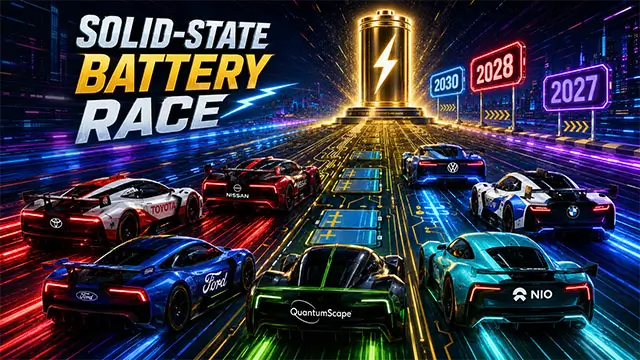
When Will Solid State EVs Arrive?
Most analysts converge on a 2027–2030 timeframe for the first mass market vehicles with true solid-state batteries, beginning with premium models. Goldman Sachs, in a 2023 research note, pointed to 2028 as a realistic year for initial production. Until then, incremental improvements in conventional lithium ion—such as silicon rich anodes and cell to pack designs—will continue to narrow the gap.
Conclusion
Solid state batteries represent a genuine step change, not just an incremental upgrade. If the manufacturing and cost challenges can be solved, they will make EVs lighter, safer, and as convenient to recharge as filling a gas tank. The race is no longer about whether solid state technology will arrive, but about which company can mass produce it reliably and affordably first. For the EV revolution to be truly complete, solid state batteries are indeed the missing link.