

Core Takeaway: Zero Trust is a cybersecurity framework built on “never trust, always verify.” No user, device, or application is automatically trusted—even inside the network. Every access request is explicitly authenticated, authorized with least privilege, and continuously monitored. This model, formally defined in NIST SP 800-207, replaces the obsolete castle and moat perimeter, stops lateral movement after breaches, and is driven by cloud adoption, remote work, ransomware, and regulatory mandates such as U.S. Executive Order 14028.
What Is Zero Trust?
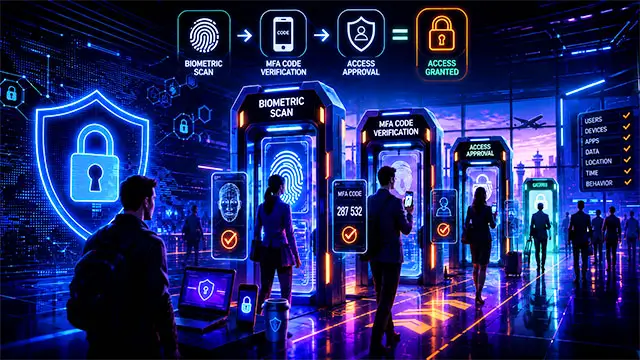
Zero Trust means no one gets a free pass. Coined by Forrester Research analyst John Kindervag in 2010, the concept treats every connection as potentially hostile, demanding strict identity verification and access control at every step. Imagine needing a passport and a fresh visa at every door inside an airport—not just at the main entrance. The framework, as codified by the National Institute of Standards and Technology (NIST) in its special publication SP 800-207, assumes a breach has already occurred and limits the blast radius by granting only the minimum required access.
The Death of the Traditional Perimeter
The old security model trusted everything inside the corporate network. That worked when applications sat in on premises data centers and employees used company owned PCs at fixed desks. Today:
• Data lives across multiple clouds and SaaS apps.
• Employees work from personal devices and home networks.
• Contractors and partners need limited access without being fully inside the network.
A single stolen password can now give an attacker unlimited internal reach. The 2023 Verizon Data Breach Investigations Report found that stolen credentials were involved in 49% of all breaches, and lateral movement remains a key tactic in ransomware incidents. High profile breaches like the Colonial Pipeline attack and the SolarWinds compromise demonstrated how once inside, attackers move undetected for weeks. Zero Trust stops that movement by requiring fresh authentication for every lateral hop.
Core Principles of Zero Trust
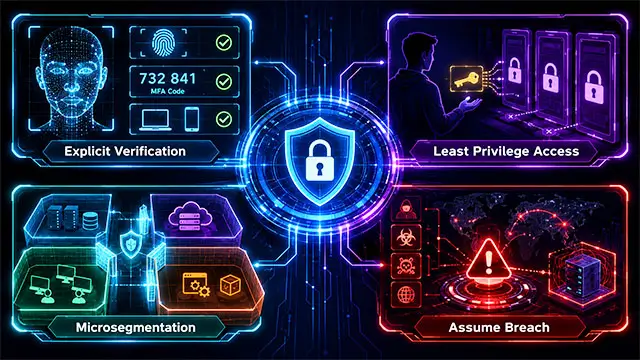
Based on NIST SP 800-207 and guidance from the Cybersecurity and Infrastructure Security Agency (CISA), genuine Zero Trust implementation rests on:
• Explicit verification: Authenticate and authorize using all available data—user identity, device health, location, and data sensitivity. Multi factor authentication (MFA) is mandatory.
• Least privilege access: Grant only the permissions needed for a specific job, and only for as long as necessary (just in time access). A marketing intern never gets access to financial databases.
• Microsegmentation: Divide the network into tiny, isolated zones. Compromising one server doesn’t grant access to another; every hop requires re authentication.
• Assume breach: Inspect and log all traffic. Use advanced analytics to detect suspicious behavior in real time, acting as if an attacker is already present.
Why Zero Trust Matters Now
• Remote and hybrid work: Employees routinely access resources from unmanaged networks, making perimeter based trust irrelevant.
• Cloud and SaaS explosion: Critical applications run outside the traditional data center, so trusting internal IP addresses is meaningless.
• Ransomware and nation state threats: Attackers exploit even minor misconfigurations to gain a foothold and move laterally.
The 2023 Mandiant M-Trends report noted a steady increase in attacker dwell time when lateral movement is not contained.
• Regulatory pressure: The U.S. Executive Order 14028 on improving the nation’s cybersecurity mandates that federal agencies adopt Zero Trust architectures. CISA’s Zero Trust Maturity Model provides a roadmap for implementation, and cyber insurers increasingly demand Zero Trust controls before issuing policies.
Implementing Zero Trust: A Journey, Not a Project
Zero Trust requires cultural and technological shifts, as outlined in CISA’s Zero Trust Maturity Model and NIST’s implementation guidelines:
• Invest in identity and access management (IAM) and multi factor authentication.
• Map data flows and apply microsegmentation gradually.
• Continuously monitor and refine policies using security analytics and SOAR platforms.
• Challenge the assumption that “inside equals safe.”
Conclusion: Skepticism as the Highest Form of Protection
The days of a secure perimeter are over. As NIST, CISA, and industry leaders emphasize, organizations that verify everything and trust nothing will thrive. Zero Trust isn’t a product—it’s a mindset. And in cybersecurity today, skepticism is your strongest defense