
Core Takeaway: The global race to regulate AI is accelerating, with major economies enacting landmark laws to govern artificial intelligence. Yet even the most forward‑thinking policies struggle to match the blistering pace of AI development, creating a persistent gap between innovation and oversight. Striking a balance between safety and progress is the defining challenge of AI governance today.
A World of Regulatory Fragmentation
In 2024, the European Union adopted the world’s first comprehensive AI law. The EU AI Act classifies AI systems by risk, bans unacceptable uses such as social scoring, and imposes strict transparency and safety requirements on high‑risk applications. Companies that violate the rules face fines of up to 7% of global annual turnover. European Commission President Ursula von der Leyen called it “a historic first,” and it has already become the de facto global benchmark for AI regulation.
The United States has taken a different path. In late 2023, President Biden issued an executive order on AI, invoking the Defense Production Act to compel developers of the most powerful models to share safety test results with the government. But a comprehensive federal AI law remains stalled in Congress, leaving a patchwork of state‑level proposals and voluntary commitments from major tech firms.
China, meanwhile, has enacted binding rules for generative AI, requiring algorithmic transparency, content controls, and security assessments before public release. Other countries, from Canada to Brazil, are crafting their own frameworks, creating a fragmented global landscape where a model approved in one jurisdiction may be illegal in another.
The Pace Problem
AI regulation faces an inherent temporal mismatch. While the EU AI Act took nearly three years to negotiate, the capabilities of frontier models have transformed completely in the same period. A 2024 Stanford HAI report noted that language models now routinely pass bar exams and medical licensing tests—benchmarks that were barely imaginable when the first regulatory drafts were written.
This lag fuels concerns that rules will be outdated before they take effect. Some experts, including researchers from the Brookings Institution, argue for agile governance models that rely on iterative updates, regulatory sandboxes, and close cooperation with industry rather than rigid legislation.
Industry Pushback and Self‑Governance
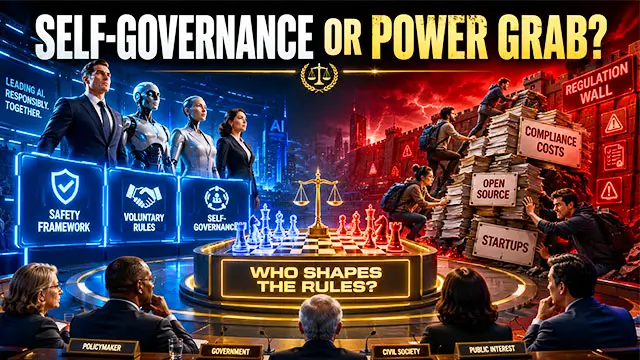
Major AI companies have not waited for regulation. OpenAI, Anthropic, Google DeepMind, and Microsoft have all published their own safety frameworks and participated in White House‑brokered voluntary commitments. Sam Altman, CEO of OpenAI, told a U.S. Senate hearing that “regulatory intervention by governments will be critical to mitigate the risks of increasingly powerful models,” but he also warned against rules that could stifle startups and open‑source innovation.
The risk of regulatory capture looms. Critics argue that large incumbents can bear compliance costs that smaller competitors cannot, potentially concentrating power. As a result, the regulatory race is also a battle over who gets to shape the rules of the game.
What Comes Next
International coordination efforts, such as the UK’s AI Safety Summit and the G7’s Hiroshima AI Process, have produced shared principles but no binding treaties. The United Nations has created an AI advisory body, but global consensus remains distant.
The great AI regulation race is far from over. Policymakers are being forced to make high‑stakes decisions with incomplete information, balancing the promise of AI‑driven breakthroughs in medicine and climate against the risks of mass disinformation, labor disruption, and autonomous weapons. The question is not whether regulation will catch up, but whether it will arrive in time to guide—not simply react to—the AI revolution.