

The central takeaway is that edge computing fundamentally shifts data processing from far-away cloud centers to the immediate source of data—factories, vehicles, stores, and devices—delivering near-instant response times, dramatically lower bandwidth costs, and stronger local privacy. Rather than replacing the cloud, edge handles real-time, context-sensitive decisions where speed and security are critical, while the cloud continues to manage long-term analytics, model training, and global orchestration. Together, they form a hybrid architecture that is already reshaping industries like manufacturing, healthcare, retail, and autonomous driving, and redefining the internet’s future by making the default no longer “send everything to the cloud.”
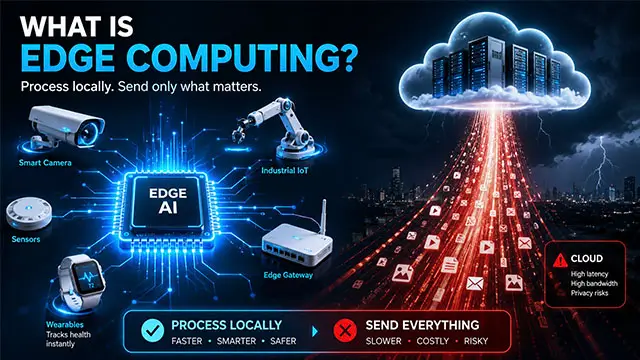
What is edge computing?
Edge computing is a distributed model that processes data near its source rather than sending everything to a centralized cloud. Edge devices—small computers, gateways, or servers—sit next to cameras, sensors, and machines. They analyze, filter, and act on data locally. For example, a security camera with edge AI doesn’t stream all footage to the cloud; it detects an intruder in real time and only then sends an alert with the relevant clip. The principle: process locally, send only what matters.
Why the cloud is no longer the default?
1. Latency is unacceptable. Autonomous vehicles need sub-10-millisecond responses to avoid collisions. Augmented reality demands instant alignment of virtual and real worlds. Edge computing eliminates the long-distance delay to the cloud, keeping latency in single-digit milliseconds.
2. The data explosion is here. Over 41 billion IoT devices are projected by 2027, generating 180 zettabytes of data. Sending all of it to the cloud is bandwidth-prohibitive. Edge filters raw data locally, transmitting only actionable insights.
3. Privacy and security demand local processing. Medical records, factory secrets, and personal conversations are vulnerable when they leave the premises. Edge keeps sensitive data inside the secure perimeter, aiding compliance with GDPR and industry regulations.
Where edge computing shines: key industries
• Manufacturing: Sensors predict equipment failures hours in advance, preventing downtime. Edge systems run autonomously even if the internet connection drops.
• Healthcare: Wearable ECGs and smart beds process vitals locally. Dangerous arrhythmias trigger instant alerts without waiting for cloud servers. Raw patient data stays within the hospital’s secure network.
• Retail: Smart checkouts track items and charge customers automatically. Local processing eliminates peak-hour delays, delivering a seamless “grab-and-go” experience.
• Autonomous Vehicles: On-board computers handle split-second driving decisions. Later, aggregated data uploads to the cloud for model training, but safety-critical paths remain fully edge-based.
• Smart Cities: Traffic cameras and environmental sensors manage infrastructure locally, adjusting signals in real time and alerting emergency services without constant cloud streaming.
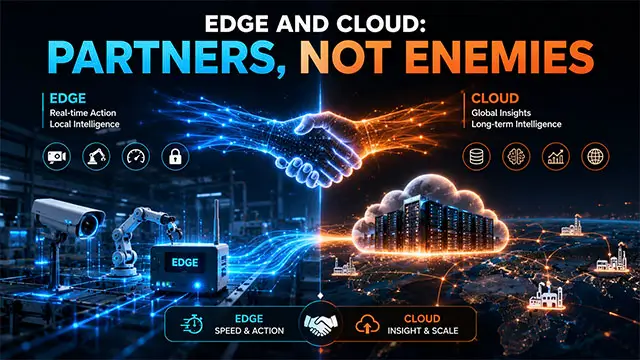
Edge and cloud: partners, not enemies
Edge computing is not a cloud killer. It handles real-time, contextual decisions where immediate action and privacy are essential. The cloud aggregates long-term data, trains machine learning models, and manages global operations. A smart factory, for instance, might use edge gateways for local machine monitoring while the cloud analyzes performance trends across multiple plants worldwide.
Challenges on the edge frontier
Managing thousands of distributed edge devices is complex, requiring robust security, updates, and configuration. Physical security risks are higher than in guarded data centers. Edge hardware often operates in harsh environments, demanding resilient, energy-efficient designs. Despite these hurdles, 5G and future 6G networks will accelerate edge adoption, enabling ultra-reliable low-latency applications like remote surgery and holographic collaboration.
Conclusion
The era of sending all data to the cloud by default is ending. Edge computing places intelligence right next to the action—not rejecting the cloud, but making smarter decisions about what travels there. By processing data locally, edge delivers the speed, privacy, and bandwidth efficiency that modern connected devices demand. Your data doesn’t need the cloud anymore—at least, not all of it. That shift will reshape the internet for the next decade.