
For decades, professionals were told to pick a lane and stay in it. Specialization was the golden ticket—become the undisputed expert in one narrow field, and job security would follow. But the rules have changed. In today’s rapidly evolving economy, where AI can master specific tasks overnight, a new model is emerging as the winning formula: the T-shaped professional.
What Is a T-Shaped Professional?
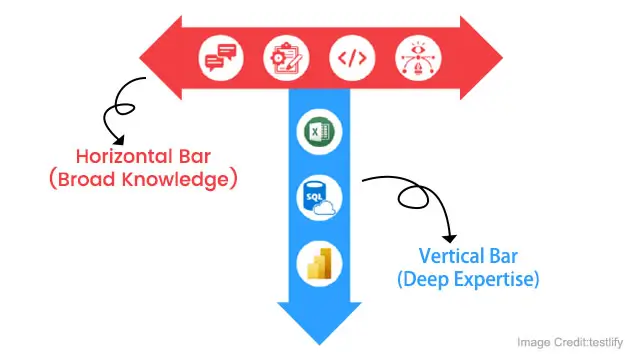
A T-shaped professional combines two critical dimensions of capability. The vertical bar of the “T” represents deep expertise in a single domain—your core specialty where you deliver undeniable value. The horizontal bar represents broad, working knowledge across multiple adjacent disciplines, along with essential soft skills like communication, collaboration, and adaptability.
This isn’t about being a jack-of-all-trades and master of none. It’s about having a home base of expertise while possessing the versatility to connect, collaborate, and contribute beyond your immediate role.
Why T-Shaped Beats I-Shaped Today
The era of the “I-shaped” specialist—deep knowledge in one area and little else—is fading for several compelling reasons.
AI is automating narrow expertise. Machines excel at specific, repeatable tasks. As AI handles more specialized functions, what remains for humans is the messy, interdisciplinary work that requires judgment, creativity, and contextual understanding. T-shaped professionals thrive in this space because they can see connections that pure specialists miss.
Complex problems demand cross-functional solutions. Innovation rarely happens within a single silo. The most valuable insights emerge at the intersection of disciplines. When you understand not just your domain but how it interacts with others, you become the person who can bridge gaps, translate between teams, and drive holistic solutions.
Versatility creates resilience. Companies restructure. Technologies become obsolete. Markets shift overnight. Specialists who cannot adapt face redundancy, while T-shaped professionals can pivot into new roles without starting from zero. Their breadth provides a safety net that pure depth cannot.
The Business Case for Breadth
Organizations are voting with their hiring dollars. Demand for cross-functional skills has grown significantly—product management job postings now list data analysis (31%) and project management (21%) alongside core product expertise, a combination that would have been split across three roles just five years ago.
T-shaped team members reduce bottlenecks and improve continuity. When someone understands adjacent domains, they can cover for colleagues, contribute to multiple phases of a project, and keep work flowing even when specialists are unavailable. This flexibility is particularly valuable in agile environments where requirements change rapidly.
Real-World Proof
History’s most influential technologists exemplify T-shaped thinking. Linus Torvalds mastered kernel engineering (his vertical depth) but paired it with understanding of version control, collaboration models, and software architecture—the horizontal breadth that made Git possible. Guido van Rossum didn’t just design Python; he understood developer experience, documentation, and education, which is why Python succeeded where other languages failed.
Elon Musk’s depth in physics-based engineering combines with broad knowledge of software, manufacturing, and systems integration, allowing him to lead companies across multiple industries simultaneously. A purely specialized mind couldn’t operate at that scale.
How to Build Your T-Shape
Developing T-shaped skills is a deliberate journey, not an accident.
First, establish your vertical. Choose one domain to master deeply. This is your anchor—the area where you can solve complex problems, mentor others, and be the go-to expert. Don’t spread yourself thin before building this foundation.
Then, expand horizontally. Identify two to four adjacent skills that complement your core. If you’re a backend developer, learn frontend basics, DevOps fundamentals, and system design. If you’re a marketer, understand data analytics, UX principles, and product strategy. The goal is functional literacy, not mastery—enough to collaborate intelligently and see the bigger picture.
Cultivate soft skills deliberately. Communication, empathy, and systems thinking form the glue of the horizontal bar. Practice explaining technical concepts to non-technical audiences. Learn to trace how your work impacts other functions and the business as a whole.
Build projects that require breadth. A simple application deployed to the cloud teaches more about full-stack development than any course. Cross-functional projects force you to stretch beyond your comfort zone while keeping your core sharp.
The Sweet Spot: Depth Plus Breadth
The T-shaped model isn’t about choosing between specialization and generalization—it’s about integrating both. Deep expertise gives you credibility and indispensable value. Broad knowledge gives you adaptability and perspective.
As one observer noted, “Depth creates mastery. Width creates opportunity. The best professionals learn when to use both”. In a world where change is the only constant, that combination isn’t just advantageous—it’s essential.
Conclusion: Shape Yourself for What’s Coming
The future doesn’t belong to the narrowest specialist or the broadest generalist. It belongs to those who can go deep when depth matters and wide when connection counts. The T-shaped professional embodies this balance, combining the focus of an expert with the curiosity of a learner.
Building your T takes time and intention. But in an economy that rewards versatility as much as expertise, it’s the shape that will carry you forward. Start by deepening your core. Then start stretching. The intersection is where the future lives.