
Artificial intelligence has grown remarkably skilled at finding patterns. It can detect tumors in medical scans, translate languages, and generate human-like text. Yet beneath the surface, most of today’s AI systems operate on a fundamentally shallow principle: statistical correlation. They recognize that certain inputs are associated with certain outputs, but they don’t truly understand why. The next frontier—and perhaps the hardest—is teaching machines to grasp cause and effect. This shift from pattern matching to causal understanding promises to make AI not just smarter, but also safer, fairer, and more trustworthy.
The Limits of Pattern Matching
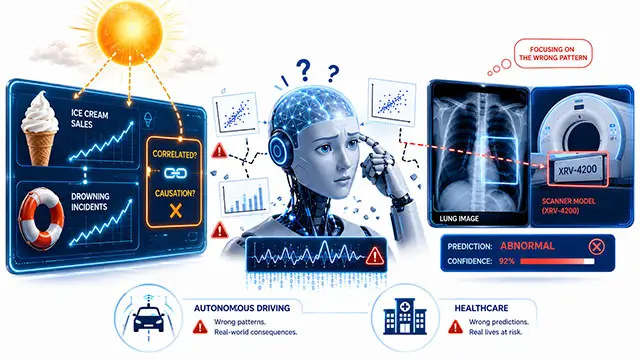
Modern deep learning models excel at spotting correlations in vast datasets. A classic example illustrates the problem: an AI might notice that ice cream sales and drowning incidents rise and fall together. Without causal reasoning, it might naively conclude that ice cream causes drowning—or vice versa. Humans instantly recognize that hot weather drives both. This failure to distinguish correlation from causation can lead AI to learn spurious shortcuts, such as diagnosing pneumonia based on the hospital machine that took the X-ray rather than the image itself. When deployment conditions change, these brittle associations break, sometimes with dangerous consequences in high-stakes domains like healthcare or autonomous driving.
What Causal Understanding Brings
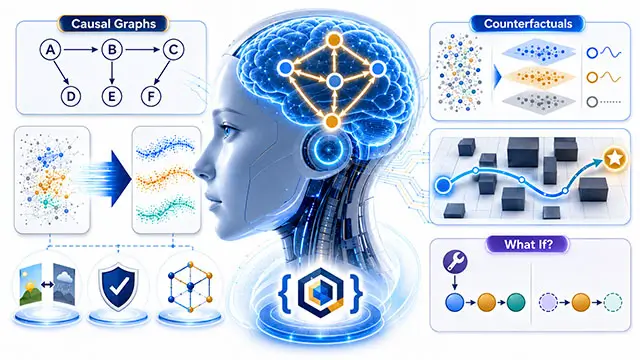
Causal understanding allows a system to answer three layers of questions beyond mere association. The first is intervention: “If I change X, what happens to Y?” The second is counterfactuals: “What would have happened if I had done Z instead?” The third is credit assignment: “Which factor actually produced this outcome?” These capabilities mirror how humans reason and plan. A self-driving car with causal reasoning would not just brake when it sees a ball roll onto the street; it would infer that a child might follow and slow down preemptively. A medical AI could distinguish between a treatment that truly cures and one that merely correlates with recovery because healthier patients receive it.
How AI Is Learning to Reason Causally
The theoretical backbone comes from the work of researchers like Judea Pearl, who formalized causal inference using directed acyclic graphs and the do-calculus. More recently, machine learning practitioners have begun blending these frameworks with neural networks. Techniques like causal representation learning, invariant risk minimization, and counterfactual data augmentation are enabling models to disentangle causal factors from noise. In industry, major players are investing heavily: IBM has open-sourced a causal inference toolkit, and DeepMind has applied causal reasoning to reinforcement learning agents, enabling them to learn more robust policies from fewer examples. Even large language models are being fine-tuned to generate “what-if” scenarios and reason over causal chains, though their understanding remains shallow and largely verbal.
The Challenges Ahead
Moving from pattern matching to genuine causal reasoning is not a simple upgrade. True causal models require either experimental data from randomized controlled trials—expensive and often unethical to collect—or strong assumptions about the data-generating process. The real world is noisy, with countless hidden confounders. Scalable algorithms for discovering causal structure from purely observational data remain elusive, and benchmarking causal abilities is still a nascent field. There is also the challenge of integrating causal reasoning into the foundation model pipeline, which currently thrives on massive passive correlation.
Despite these hurdles, the push toward causal AI is gaining momentum. Regulators are beginning to demand explainability, and businesses need models that work under distribution shift. An AI that understands why will not only perform better but also earn our trust. As the initial excitement around generative models matures, the quiet revolution in causal reasoning may well define the next decade of artificial intelligence. The leap from pattern matching to causal understanding is not just a technical milestone—it is the path to machines that can truly think.