
Google’s Gemini has been on an impressive upgrade streak, and its latest features bring AI out of the chat window and into entirely new dimensions—literally. From generating interactive 3D simulations with a simple text prompt to powering voice assistants inside millions of vehicles, Gemini is evolving into something far more useful than a chatbot. Here’s what’s new and why it matters.

Interactive 3D Models: Seeing Is Understanding
In April 2026, Google rolled out a major update that lets Gemini generate fully interactive 3D models and real-time physics simulations directly within the chat interface. Users simply select the Pro model and phrase their prompt with phrases like “show me” or “help me visualize” to trigger the feature. Within seconds, Gemini produces a controllable, three-dimensional visualization that users can rotate, zoom, and adjust using sliders and input fields.
The range of applications is remarkably broad. You can ask Gemini to simulate the moon orbiting the Earth, complete with a speed slider, a toggle for the orbital path line, and a pause button to freeze the motion. Physics concepts like the double pendulum or the Doppler effect become tangible as you tweak variables such as gravity strength or wave speed and watch the simulation change in real time.- For biology and chemistry, molecules can be rotated and examined from multiple angles, making abstract concepts far more accessible than any static textbook diagram ever could.
The significance goes beyond education. This marks a shift from AI that tells you about things to AI that shows and demonstrates. Anthropic added interactive diagrams to Claude around the same period, and OpenAI brought similar visual tools to ChatGPT, showing that the race among major AI platforms to move beyond flat text and images into interactive, spatial computing is accelerating fast.
In-Car AI: Gemini Takes the Wheel (Conversationally)
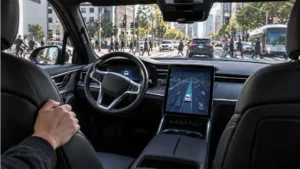
While the 3D feature was stealing headlines, Gemini was quietly rolling into millions of vehicles. Starting April 30, 2026, Google began pushing Gemini to cars equipped with Google built-in, replacing the older Google Assistant with a far more capable conversational AI. General Motors was an early adopter, making roughly 4 million vehicles across its Cadillac, Chevrolet, Buick, and GMC brands eligible for the upgrade. Polestar and Volvo models in the US have also received the new AI assistant, covering vehicles from the C40 and XC40 to the EX90 and ES90.
The core improvement is natural conversation. Traditional in-car voice systems demand rigid, memorized commands. Gemini understands context, handles follow-up questions, and lets drivers speak naturally. You can say, “It’s foggy and freezing in here,” and the assistant will understand to turn up the heat and activate the defrosters without you needing to spell out each function. I can access your vehicle’s owner manual to answer model-specific questions, monitor your EV battery status, find charging stops along your route, and even send texts translated into different languages—all hands-free.
The integration goes deeper with Google built-in. During a demo with the Volvo EX60, Gemini was able to control vehicle-specific settings—darkening the sunroof from transparent to opaque upon a simple voice request—and describe footage from the car’s front-facing cameras in real time.
A Competitive Landscape in Motion
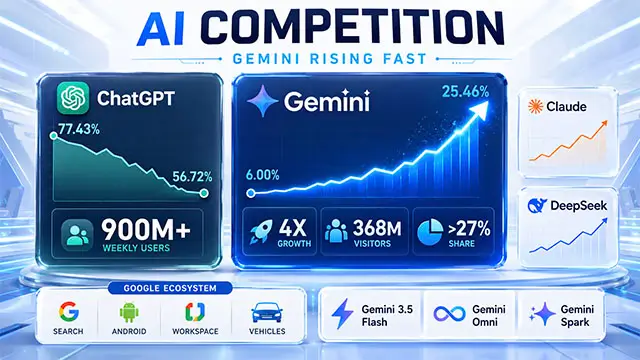
These upgrades come at a critical moment in the AI arms race. According to Similarweb data as of March 2026, ChatGPT’s global generative AI website traffic share has dropped from 77.43% to 56.72% over the past twelve months, while Gemini has surged from 6.00% to 25.46%—more than quadrupling its market share. Piper Sandler analysis shows Gemini attracted approximately 368 million unique visitors in March 2026, while SEMRush data indicates its market share of unique visitors reached over 27%, up from just 13.8% in August 2025.
Google’s platform strategy is a key driver. By integrating Gemini directly into Search, Android, Workspace, and now vehicles, Google ensures that billions of users encounter Gemini by default rather than through a deliberate choice. The company has also launched Gemini 3.5 Flash—a faster model with improved reasoning, coding, and multi-step task execution—alongside Gemini Omni for multimodal video editing and Gemini Spark, a personal AI agent that can manage background tasks like flagging subscription fees or drafting project emails.
However, ChatGPT still commands a dominant lead in raw user numbers, with roughly 900 million weekly active users compared to Gemini’s over 900 million monthly active users as of May 2026.The market is shifting from a single-player game to a multipolar competitive system, with Claude and DeepSeek also carving out their own niches.
Conclusion: AI as an Everyday Layer
Gemini’s interactive 3D models and in-car assistant represent more than feature updates—they signal a fundamental shift in how AI embeds itself into daily life. Whether it’s helping a student visualize quantum physics or guiding a driver through rush-hour traffic with natural conversation, Gemini is moving from a tool you open to a layer that works quietly in the background.
With over 2.5 billion cars already running Android Auto worldwide and the Gemini app now supporting more than 70 languages across 230 countries, Google is building an AI ecosystem that’s hard to escape—and even harder to beat. The question is no longer whether AI will be part of your car or your classroom. It already is. The real question is how quickly you’ll take it for granted.