
On April 17, 2026, xAI did something very Elon Musk—it dropped Grok 4.3 Beta without a press release, without a blog post, and without any fanfare. The model simply appeared in the selector on grok.com, flagged as “Early Access,” and early testers started discovering what it could actually do. What they found was a genuine surprise: Grok 4.3 isn’t just a modest reasoning upgrade. It’s a fundamentally more practical AI that can generate native PDFs, PowerPoint decks, Word documents, and Excel spreadsheets, understand video content conversationally, and reason through complex problems with a 2-million-token context window. The gap between chatbot and productivity platform just got a lot narrower.
Native File Generation: The Headline Feature
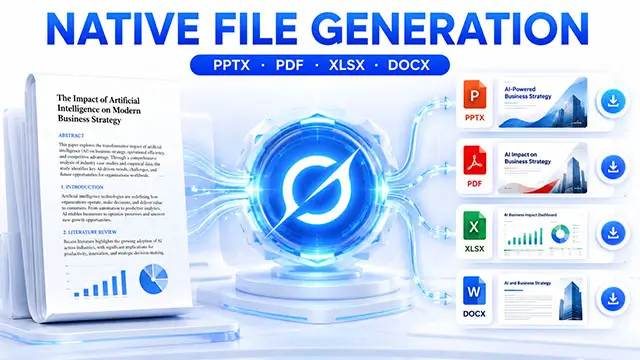
The most immediately useful addition in Grok 4.3 is its ability to generate fully formatted, downloadable office files directly from a conversation. Tell Grok to create a PowerPoint presentation based on a research paper, and it will produce a polished, ready-to-present .pptx file—not a rough outline or a text summary, but an actual slide deck you could hand to a colleague. The same applies to PDFs and Excel spreadsheets. This might sound like a small thing, but until now, most AI chatbots would apologize when asked to generate a proper file, offering markdown or plain text instead.
Early testers have been notably impressed. xAI senior engineer Matthew Dabit demonstrated the capability by feeding Grok a dense neuroscience research paper and getting back a clean, nine-slide academic presentation in minutes. Technology commentator Mario Nawfal, who has 3.36 million followers on X, reacted with genuine enthusiasm: “Grok can now spit out full Microsoft Word docs, PDFs, PowerPoints, and Excel spreadsheets on command. No more ‘sorry I can’t generate files’ excuses, this AI is actually useful AF”. This is the kind of practical utility that moves AI from being an interesting novelty to being something professionals genuinely rely on.
Native Video Understanding: AI That Sees Moving Pictures
While competitors have been adding multimodal capabilities piece by piece, Grok 4.3 introduces native video input support that allows users to upload video clips or share links for conversational analysis. The system can identify objects, describe event sequences, analyze scenes across timelines, and pinpoint timestamp-specific content—essentially reasoning about what’s happening in moving images rather than just describing static frames.
This opens up concrete use cases that go far beyond novelty. Content creators can upload rough footage and ask Grok to identify the best takes. Security teams can analyze surveillance footage for specific events. Educators can share demonstration videos and ask Grok to generate step-by-step written instructions. Researchers can process recorded experiments and extract observational data. By treating video as a first-class input modality rather than an experimental afterthought, Grok 4.3 positions itself as a genuine tool for workflows where visual information matters.
Deeper Reasoning, Smarter Automation
Under the hood, Grok 4.3 retains the 16-agent Heavy reasoning architecture and 2-million-token context window from Grok 4.20, which remains the largest among Western closed models. But the reasoning engine itself has been refined: longer training runs have produced what early testers describe as more coherent multi-step reasoning and improved instruction following, particularly on complex agentic tasks.
Grok 4.3 also introduces three operating modes—Auto, Fast, and Expert—that let users control how much computational effort the model applies to each prompt. Need a quick answer? Use Fast. Working through a complex legal document? Switch to Expert. This granularity is genuinely useful for professionals who switch between different types of tasks throughout the day.
Pricing and Availability
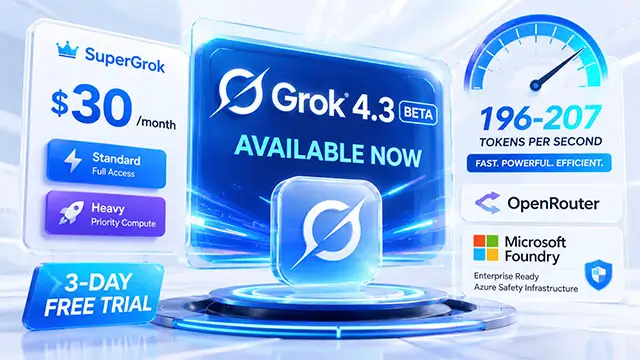
xAI quickly course-corrected: by late April 2026, the model became available to all SuperGrok subscribers at the $30/month price point, with the Heavy tier offering priority compute rather than exclusive access. SuperGrok also offers a 3-day free trial for those wanting to test the features before committing.
The model delivers output at approximately 196-207 tokens per second, placing it among the fastest in its class. Grok 4.3 is also accessible through OpenRouter and has been added to Microsoft Foundry for enterprise deployments, complete with Azure’s safety infrastructure.
What’s Still Missing
For all its practical strengths, Grok 4.3 has notable gaps. The most conspicuous absence is persistent memory between sessions—a feature that both ChatGPT and Claude have offered for over a year. At any price point, this is a limitation worth acknowledging: Grok will not remember your preferences, ongoing projects, or personal context from one conversation to the next. Users managing long-term workflows will need to re-establish context manually each time.
There’s also the broader competitive reality. While Grok 4.3 excels at practical file generation and professional-domain reasoning, it still trails GPT-5.5 and Claude Opus 4.7 on raw general intelligence benchmarks. Independent evaluations describe the model as a strong performer in legal and financial contexts but note that its mixed results in coding and mathematics may limit broader adoption. The always-on reasoning architecture, while beneficial for accuracy, can also introduce latency in scenarios where speed matters more than precision.
Conclusion: Practical AI That Ships
Grok 4.3 Beta represents a meaningful shift in what AI assistants can actually produce, not just what they can say. The ability to generate real, downloadable PowerPoint presentations, PDFs, and Excel files—combined with native video understanding, deeper reasoning, and a significantly more accessible price point—makes this release feel less like a tech demo and more like a tool people will genuinely use in their daily work.
The quiet launch strategy may have been deliberate: rather than overpromising on benchmarks and AGI timelines, xAI shipped something practical and let users discover its value through actual use. At $30/month with a free trial available, Grok 4.3 is now accessible enough that the best way to evaluate it is simply to try it yourself. The AI assistant that can actually do things, not just talk about them, has arrived.